Last Updated: 18 September 2026
“It means a lot to me” is one of the most overused phrases in English, and once you notice it, you’ll hear it everywhere — in thank-you cards, work emails, wedding speeches, and text messages to friends. It’s not wrong. It’s just tired. If you want your gratitude to actually land, you need other ways to say it means a lot to me that match the moment, whether that’s a heartfelt note to a parent, a polite reply to your manager, or a quick text to a close friend.
In this guide, I’ll walk you through 16+ natural, grammatically correct alternatives, grouped by tone: formal, informal, and professional. I’ll explain why each one works, show you a real example sentence, and flag the small grammar details (like verb agreement and preposition choice) that trip people up. I edit student essays and business emails for a living, and this exact phrase is one of the most common ones I rewrite — so everything here comes from real usage, not a thesaurus dump.
Why “It Means a Lot to Me” Needs Alternatives
“It means a lot to me” is grammatically fine, but it’s vague and repeated so often that it can sound automatic rather than sincere. The phrase uses the verb mean (present tense, third person singular: it means) followed by the idiom a lot to me, which functions as an intensifier of importance. That structure works, but it doesn’t tell the reader how something matters to you.
I see this in student essays and workplace emails constantly: someone writes “it means a lot to me” as a closing line, and it reads as filler rather than emotion. Swapping in a more specific phrase — one that names the feeling (gratitude, relief, pride, encouragement) — makes your writing sound like you wrote it, not a template.
Here’s what changes when you diversify your phrasing:
- Tone precision — you can match formal, casual, or professional registers exactly.
- Emotional clarity — some alternatives show gratitude, others show significance or emotional weight.
- Avoiding repetition — useful in essays, cover letters, or thank-you messages where repeating one phrase looks careless.
- Cultural naturalness — native speakers rotate between these phrases automatically, and non-native speakers who only know one version stand out.
Formal Alternatives to “It Means a Lot to Me”
Formal alternatives work best in written correspondence, academic writing, official thank-you letters, and any situation where you want warmth without sounding casual. These phrases lean on more elevated vocabulary while keeping the sentiment sincere.
1. “I am deeply grateful for…”
This is one of the safest formal openers because deeply grateful is a fixed, widely accepted collocation in English. Use it when thanking someone in a letter, speech, or formal email.
Example: “I am deeply grateful for the support you gave me during my recovery.”
2. “This gesture is truly appreciated.”
Appreciated is the past participle of appreciate, used here as a passive adjective. It works well in written thank-you notes and formal replies because it centers the action, not just your feelings.
Example: “This gesture is truly appreciated, and I won’t forget your generosity.”
3. “Your kindness has touched me profoundly.”
Touched here is used figuratively — it means “emotionally affected” — and profoundly is the adverb that raises the register. This is a strong choice for eulogies, formal letters, or wedding speeches.
Example: “Your kindness has touched me profoundly during a very difficult year.”
4. “I hold this in the highest regard.”
Regard functions as a noun meaning “respect or esteem.” This phrase works when you want to express that something (an opportunity, a gift, an honor) carries real weight for you, without naming a specific emotion.
Example: “I hold this recommendation letter in the highest regard.”
5. “Words cannot fully convey my gratitude.”
This is a classic formal idiom that admits language has limits — which, ironically, makes the sentiment feel bigger. Reserve it for genuinely significant moments; overusing it dilutes the effect.
Example: “Words cannot fully convey my gratitude for your mentorship over the years.”
6. “I am profoundly moved by your generosity.”
Moved (past participle of move, used figuratively) pairs naturally with profoundly or deeply. This alternative is common in formal thank-you speeches and acceptance remarks.
Example: “I am profoundly moved by your generosity toward the scholarship fund.”
Informal Alternatives to “It Means a Lot to Me”
Informal alternatives are for texts, casual conversations, social media captions, and messages to friends or family — anywhere a stiff, formal phrase would feel out of place. These lean on everyday vocabulary and contractions.
7. “That really means the world to me.”
The world is a hyperbole (an exaggeration for effect) that ramps up the intensity of the original phrase. It’s extremely common in everyday spoken English.
Example: “Thanks for remembering my birthday — that really means the world to me.”
8. “You have no idea how much this means.”
This phrase uses an implied comparison — the listener can’t fully grasp the depth of your gratitude. It sounds natural in text messages and spoken conversation.
Example: “You have no idea how much this means, honestly.”
9. “I’m so touched, thank you.”
Short, direct, and natural in speech. Touched here works the same way as in the formal section, but the informal delivery (contraction, short sentence) shifts the register down.
Example: “I’m so touched, thank you for thinking of me.”
10. “This hit me right in the feels.”
A modern, slang-adjacent phrase popular in texting and social media. The feels is informal slang for “strong emotions.” Use it only with people you know casually — it would sound out of place in a cover letter.
Example: “That video of you two hit me right in the feels.”
11. “You made my day.”
A simple, warm idiom that shifts focus from the object or gesture to the effect it had on you. Common in casual thank-you texts.
Example: “Seeing that message this morning made my day.”
12. “I can’t thank you enough.”
This is a common exaggeration (you could thank someone, but the phrase implies gratitude beyond words). It works in both casual and semi-formal contexts, which makes it flexible.
Example: “I can’t thank you enough for helping me move last weekend.”
Professional Alternatives to “It Means a Lot to Me”
Professional alternatives are built for workplace emails, performance reviews, client communication, and LinkedIn messages, where you want to sound polished, sincere, and career-appropriate — not overly emotional, and not stiff either. These strike a middle ground between formal and casual.
13. “I sincerely appreciate your support.”
Sincerely signals genuine intent without sounding theatrical. This is one of the most versatile professional phrases — safe for emails to managers, clients, or colleagues.
Example: “I sincerely appreciate your support during the product launch.”
14. “Your feedback is genuinely valued.”
Passive construction (is valued) softens the tone slightly, which fits well in performance reviews or manager responses. Genuinely prevents it from sounding like boilerplate.
Example: “Your feedback on the proposal is genuinely valued by the whole team.”
15. “This recognition means a great deal to me professionally.”
Adding professionally narrows the context, which is useful when responding to an award, promotion, or public credit at work. It signals that the impact goes beyond a casual “thanks.”
Example: “This recognition means a great deal to me professionally, and I’m grateful to the whole team.”
16. “I want to express my sincere gratitude.”
A slightly more formal-professional hybrid, common in resignation letters, thank-you emails after interviews, and client correspondence.
Example: “I want to express my sincere gratitude for the opportunity to lead this project.”
17. “Your trust in me is something I don’t take lightly.”
This phrase shifts the focus to responsibility rather than just emotion, which reads well in leadership communication or when someone has delegated important work to you.
Example: “Your trust in me is something I don’t take lightly, and I’ll do my best to deliver.”
Quick Reference Table
| Alternative Phrase | Tone | Best Used In |
|---|---|---|
| I am deeply grateful for… | Formal | Letters, speeches |
| This gesture is truly appreciated | Formal | Thank-you notes |
| Your kindness has touched me profoundly | Formal | Eulogies, speeches |
| I hold this in the highest regard | Formal | Formal correspondence |
| Words cannot fully convey my gratitude | Formal | Major life events |
| I am profoundly moved by your generosity | Formal | Acceptance speeches |
| That really means the world to me | Informal | Texts, conversation |
| You have no idea how much this means | Informal | Texts, speech |
| I’m so touched, thank you | Informal | Casual thank-yous |
| This hit me right in the feels | Informal | Social media, texting |
| You made my day | Informal | Casual messages |
| I can’t thank you enough | Informal/Semi-formal | Everyday gratitude |
| I sincerely appreciate your support | Professional | Work emails |
| Your feedback is genuinely valued | Professional | Performance reviews |
| This recognition means a great deal to me professionally | Professional | Awards, promotions |
| I want to express my sincere gratitude | Professional | Resignation/thank-you letters |
| Your trust in me is something I don’t take lightly | Professional | Leadership communication |
Common Mistakes to Avoid
Most errors with these phrases involve mismatched tone, not bad grammar — using an informal phrase in a formal email is the mistake I flag most often when editing. A few specific issues to watch for:
- Mixing registers: Don’t pair “this hit me right in the feels” with a formal cover letter. Match tone to context every time.
- Preposition errors: It’s “means a lot to me,” not “means a lot for me.” The correct preposition after mean in this idiom is always to.
- Overusing intensifiers: Phrases like “words cannot fully convey” lose their power if you use them in every message. Save them for genuinely significant moments.
- Dropping subject-verb agreement: “This gesture mean a lot” is incorrect — it should be “This gesture means a lot,” since gesture is singular third person.
Other Ways to Say “It Means a Lot to Me” Quotes
When someone does something kind, supportive, thoughtful, or meaningful, saying “It means a lot to me” is a simple way to express genuine appreciation. However, you can use different phrases depending on the relationship and emotion behind your words. Here are some natural alternatives that work well in everyday conversations, messages, and heartfelt moments.
- “I really appreciate it.”
- “That means so much to me.”
- “I truly value this.”
- “I’m deeply grateful.”
- “I can’t tell you how much this means to me.”
- “I’m so thankful for this.”
- “Your kindness means more than you know.”
- “I’ll always appreciate what you did for me.”
- “This is incredibly meaningful to me.”
- “I’m genuinely touched.”
- “I’m grateful from the bottom of my heart.”
- “You have no idea how much I appreciate this.”
- “This really touched my heart.”
- “I’ll never forget your kindness.”
- “Your support means everything to me.”
The best alternative depends on the situation. “I really appreciate it” sounds natural and conversational, while “I’m deeply grateful” feels more heartfelt and serious. For emotional situations, “That means so much to me” or “I can’t tell you how much this means to me” can express stronger feelings without sounding unnatural.
Other Ways to Say “It Means a Lot to Me” Funny
If you want to show appreciation while keeping the conversation lighthearted, funny alternatives can make your message more memorable. These phrases work especially well with close friends, family members, or people who understand your sense of humor.
- “You just earned yourself a permanent spot in my good books.”
- “Well, now I owe you one!”
- “My heart just did a little happy dance.”
- “Okay, you officially made my day.”
- “I appreciate this more than free Wi-Fi.”
- “You’re dangerously close to becoming my favorite person.”
- “This deserves at least three thank-yous.”
- “I’m emotionally overwhelmed—in a good way.”
- “You’ve officially won the kindness award.”
- “I owe you big time!”
- “My gratitude has entered legendary status.”
- “You just upgraded your friendship membership.”
- “I would give you a five-star review for this.”
- “My heart says thank you, and my stomach says we should celebrate.”
- “You’re making it very difficult for me not to get sentimental.”
Funny alternatives are most effective when the situation is casual. If someone has helped you during a serious or emotional moment, a sincere expression of gratitude may be more appropriate than a joke.
This Means a Lot to Me Meaning
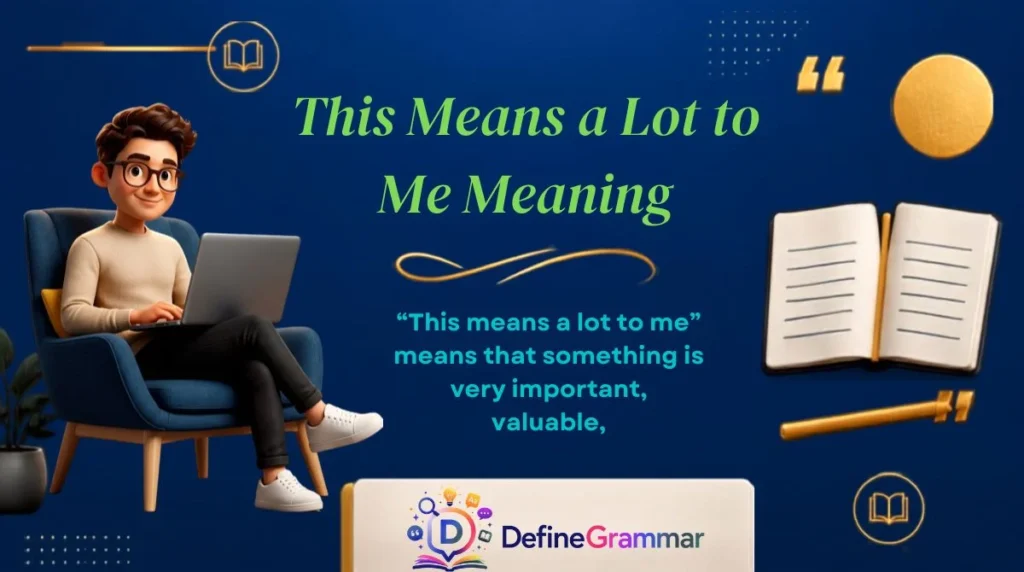
“This means a lot to me” means that something is very important, valuable, or emotionally meaningful to you. It is commonly used when someone does something kind, gives you support, shows appreciation, remembers something important, or makes an effort for you.
For example, if a friend helps you during a difficult time, you might say, “Thank you for being there for me. This means a lot to me.” Here, the phrase communicates more than a simple “thank you.” It shows that you genuinely value the person’s action and that it has an emotional impact on you.
The phrase can also describe appreciation for a gift, compliment, opportunity, achievement, or thoughtful gesture. Its exact meaning depends on context, but the central idea is always personal importance and sincere appreciation.
“It Means a Lot to Me” Formal
In formal or professional situations, “It means a lot to me” can sometimes sound personal or conversational. When you want a more polished expression, choose wording that communicates appreciation clearly and respectfully.
Some formal alternatives include:
- “I sincerely appreciate your support.”
- “I greatly appreciate your consideration.”
- “I’m truly grateful for your assistance.”
- “I deeply appreciate your kindness.”
- “Your support is greatly appreciated.”
- “I sincerely value your assistance.”
- “I’m very grateful for your thoughtful gesture.”
- “I truly appreciate the opportunity.”
- “Your consideration is greatly appreciated.”
- “I’m thankful for your continued support.”
For workplace emails, “I sincerely appreciate your assistance” is appropriate when someone has helped you. If someone has given you an opportunity, “I truly appreciate the opportunity” sounds natural and professional. In a formal thank-you message, these expressions usually sound more polished than highly emotional wording.
Means a Lot Synonyms Slang
In casual conversations, people often use shorter and more relaxed expressions instead of “it means a lot to me.” Slang can make your message sound warmer, more natural, and more personal, especially when talking with friends.
Common casual alternatives include:
- “Means so much.”
- “Means everything.”
- “Means the world.”
- “I appreciate you.”
- “You’re the best.”
- “Much love.”
- “You’re a real one.”
- “I owe you big time.”
- “You’re a lifesaver.”
- “I’m really grateful.”
- “You have no idea.”
- “That’s huge for me.”
- “I seriously appreciate it.”
- “You’re amazing for that.”
- “Much appreciated.”
For example, instead of saying “Your support means a lot to me,” a close friend might say, “I appreciate you so much” or “You’re a real one for that.” These expressions are informal, so they are better suited to texts, social media, and relaxed conversations than professional communication.
Another Way to Say “Means the World to Me”
“Means the world to me” is a stronger and more emotional alternative to “means a lot to me.” It suggests that someone or something has exceptional personal value.
You can express the same idea in several ways:
- “You mean everything to me.”
- “This is incredibly important to me.”
- “I treasure this.”
- “I value this more than you know.”
- “This is deeply meaningful to me.”
- “You’re incredibly important to me.”
- “I hold this very close to my heart.”
- “This is something I’ll always cherish.”
- “I’m more grateful than words can express.”
- “This means more to me than I can say.”
For romantic or deeply emotional situations, “You mean the world to me” is especially common. For gifts, memories, achievements, or meaningful experiences, “I’ll always cherish this” can sound more natural.
“It Would Mean the World to Me” Meaning
“It would mean the world to me” means that something would make you extremely happy or grateful if it happened. Unlike “It means the world to me,” which describes something that is already meaningful, “it would mean the world to me” usually refers to something that could happen in the future.
For example:
“It would mean the world to me if you could be there.”
This means that the person’s presence would be extremely important and meaningful to you.
The phrase is often used when making a heartfelt request without sounding demanding. It can make a request feel warmer and more sincere because it explains how much the person’s help, presence, or support would matter.
It Means a Lot Synonyms
There are many synonyms and alternative expressions for “it means a lot”, and the best choice depends on the level of emotion and formality you want.
Simple and natural alternatives:
- “I really appreciate it.”
- “That means so much.”
- “I’m very grateful.”
- “I truly value it.”
- “I’m thankful for that.”
Heartfelt alternatives:
- “It means everything to me.”
- “It means the world to me.”
- “I’m deeply grateful.”
- “I’ll always cherish this.”
- “It’s incredibly meaningful to me.”
Professional alternatives:
- “I sincerely appreciate it.”
- “I greatly value your support.”
- “I’m truly grateful for your assistance.”
- “Your support is greatly appreciated.”
- “I sincerely value your consideration.”
Casual or slang alternatives:
- “I appreciate you.”
- “You’re the best.”
- “That’s huge for me.”
- “You’re a real one.”
- “Much appreciated.”
Choosing the right synonym depends on your relationship with the other person and the situation. A professional email usually calls for “I sincerely appreciate your support,” while a personal message might sound more natural with “That means so much to me” or “You mean the world to me.”
People also search
other ways to say it means a lot to me quotes
other ways to say it means a lot to me funny
this means a lot to me meaning
it means a lot to me formal
means a lot synonyms slang
another way to say means the world to me
it would mean the world to me meaning
it means a lot synonyms
Frequently Asked Questions
What Can I Say Instead of “It Means a Lot”?
You can say “I truly appreciate it,” “It really matters to me,” or “I’m genuinely grateful.” These alternatives sound natural and heartfelt while expressing sincere appreciation without repeating the same phrase.
What Is Another Way to Say “Meant a Lot to Me”?
You could say “It was incredibly meaningful to me,” “I’ll always appreciate what you did,” or “It had a special place in my heart.” These phrases work well when you want to describe something that had a lasting emotional impact on you.
What Can I Say Instead of “It Means So Much to Me”?
Natural alternatives include “I can’t tell you how much I appreciate it,” “It’s truly meaningful to me,” and “I’m deeply grateful for this.” Each expression communicates strong appreciation while keeping the tone warm and sincere.
What Are Some Other Ways to Say “You Mean a Lot to Me”?
You can say “You’re very important to me,” “I deeply value having you in my life,” or “You hold a special place in my heart.” These expressions are especially suitable for someone you care about and want to make feel genuinely valued.
Final Thoughts
Before you settle on any phrase here, it’s worth checking how a word like grateful is actually defined, since dictionary-level accuracy is what separates a natural phrase from a mistranslated one. The real skill isn’t memorizing a list — it’s matching the phrase to the room you’re in. Use the formal options for letters and speeches, the informal ones for friends and family, and the professional phrases for anything that lands in your manager’s inbox. Once you start rotating through these naturally, “it means a lot to me” stops being a filler line and starts sounding like something you actually mean.

Riaz Ahmad is the founder and writer at DefineGrammar.com, dedicated to simplifying English grammar for students and writers worldwide. With a passion for language, he breaks down complex grammar rules into clear, practical lessons, helping readers write with confidence and clarity every day.