Last updated: 18 September 2026
You’re texting a friend, and they ask you something you genuinely have no clue about. You type “ISK” and hit send. Then you pause. Does that even look right in this chat? Would it land differently in a work Slack message?
ISK is text slang for “I don’t know,” used mostly in casual chats, Snapchat, and group texts. It’s a quick, informal way to admit you’re not sure about something without typing out the full phrase.
The problem is that ISK only works in one register: casual. Use it with your boss, in a client email, or on an application essay, and it reads as sloppy at best and unprofessional at worst. That’s exactly why this guide exists.
Below, I’ll walk you through 13+ solid alternatives to ISK, grouped by tone — casual, professional, and formal — so you always have the right words for the moment. I edit student writing and workplace messages regularly, and “I don’t know” substitutes are one of the most common gaps I see people struggle to fill naturally. This guide fixes that.
What Does ISK Mean in Text?
ISK is an abbreviation of “I don’t know,” typically typed in lowercase and used in fast, informal conversations like texting, Snapchat, or Discord.
It’s part of a small family of shorthand terms that all mean the same thing but sound slightly different depending on where they popped up:
- IDK — the most widely recognized version, standard across almost every platform
- ISK — a Snapchat-born variant, likely from users typing quickly or phonetically
- IDGAF-adjacent slang — not related, but sometimes confused with ISK by newer texters
None of these are recognized as standard English by major dictionaries. Merriam-Webster and similar reference sources treat them as informal internet shorthand, not accepted grammar. That’s an important distinction if you’re writing anything beyond a text message.
Why You Might Want an Alternative to ISK
The main reason to swap out ISK is tone — it reads as casual and can come across as careless in formal or professional writing.
Here’s when I’d steer a student or client away from ISK entirely:
- Work emails and Slack messages — even casual workplaces expect complete words in written communication
- Academic writing — professors and graders expect standard English, not texting shorthand
- Customer-facing chats — sounds unprofessional if you’re representing a business
- First conversations — using slang someone doesn’t recognize can create confusion instead of connection
I’ve seen job seekers accidentally carry texting habits into cover letters and interview follow-up emails. A recruiter reading “isk, but I’m excited to learn” instead of “I’m not certain yet, but I’m excited to learn” will notice — and not in a good way.
Casual and Everyday Alternatives to ISK
For friends, group chats, and social media, you have plenty of natural options that keep the same relaxed energy as ISK.
IDK
The classic. IDK is the most universally understood shorthand for “I don’t know” and works across nearly every messaging platform.
Example: “IDK what time we’re meeting, ask Sam.”
Not sure
A simple, honest way to admit uncertainty without sounding lazy about it.
Example: “Not sure if the store’s open today.”
No clue
Slightly more expressive than “not sure,” this phrase adds a bit of personality.
Example: “No clue what happened at the meeting, I missed it.”
Beats me
A casual, almost playful way to shrug off a question.
Example: “Why’s the WiFi down? Beats me.”
Search me
An older but still common phrase, often used with a light, joking tone.
Example: “Search me, I only started here last week.”
Your guess is as good as mine
Great for situations where you’re genuinely as confused as the other person.
Example: “Your guess is as good as mine — the app just stopped working.”
I have no idea
Straightforward and slightly more emphatic than “I don’t know.”
Example: “I have no idea who left this here.”
Alternatives for Professional and Work Messages
In work chats and emails, swap ISK for phrasing that sounds capable and honest instead of dismissive — this keeps you credible while still admitting a gap in knowledge.
I’m not sure, but I’ll find out
This one does double duty: it admits uncertainty and shows initiative in the same sentence.
Example: “I’m not sure, but I’ll find out and follow up by end of day.”
I don’t have that information right now
A polished way to say you don’t know something specific, common in customer service and client-facing roles.
Example: “I don’t have that information right now, but I can check with the vendor.”
Let me look into that
Shifts the focus from “I don’t know” to “I’m handling it,” which reads much better in professional settings.
Example: “Let me look into that and get back to you by tomorrow.”
That’s outside my current knowledge
A more formal, precise phrase useful in technical or specialist conversations.
Example: “That’s outside my current knowledge, but our engineering team would know.”
I’ll need to confirm that
Common in meetings and emails when you don’t want to guess and risk being wrong.
Example: “I’ll need to confirm that before I give you a final number.”
I’m still gathering information on that
Useful when a project or issue is ongoing and you genuinely don’t have the full picture yet.
Example: “I’m still gathering information on that — I’ll update the team Thursday.”
Formal and Academic Alternatives
For essays, reports, and formal correspondence, choose phrasing that’s precise about the limits of your knowledge rather than casual about it.
It is unclear at this time
A standard phrase in reports, research summaries, and formal announcements.
Example: “It is unclear at this time whether the results are conclusive.”
The cause remains undetermined
Common in academic and scientific writing when a full answer isn’t yet available.
Example: “The cause of the malfunction remains undetermined pending further testing.”
I am uncertain regarding this matter
A more formal register, fitting for letters, official emails, or academic correspondence.
Example: “I am uncertain regarding this matter and will consult the department for clarification.”
Further information is required to answer this fully
Useful when you want to signal that an answer exists but isn’t accessible yet.
Example: “Further information is required to answer this fully; the data set is incomplete.”
Ways to Say ISK Without Sounding Dismissive
Some “I don’t know” alternatives can sound like you’re brushing someone off, so pick phrasing that shows you still care about getting them an answer.
Watch out for these two traps:
- “Whatever” or “who knows” — technically answer the question, but often read as dismissive or annoyed
- A flat “IDK” with no follow-up — can feel like a conversation dead-end, especially in work chats
Instead, pair your uncertainty with a next step:
- “I don’t know off the top of my head, but I can check.”
- “No clue right now — want me to ask around?”
This one small habit — adding a follow-up instead of stopping at “I don’t know” — is something I coach clients on constantly. It changes a flat answer into a helpful one, without adding much length.
Common Mistakes People Make with ISK and Its Alternatives
The biggest mistake isn’t using ISK itself — it’s using texting shorthand in writing where the reader expects standard English.
A few patterns I see regularly when editing:
- Mixing slang into formal writing. ISK, IDK, or “idk lol” showing up in a cover letter or academic paper instantly undercuts credibility.
- Overusing vague fillers. Phrases like “not really sure I guess maybe” stack uncertainty instead of stating it clearly.
- Skipping the follow-up. Saying “I don’t know” and stopping there in a professional context can look like you’re not planning to find out.
- Confusing ISK with unrelated acronyms. Because ISK also refers to the Icelandic króna and an in-game currency in EVE Online, context matters — don’t assume every reader will know the texting meaning.
What Does ISK Mean on Snapchat?
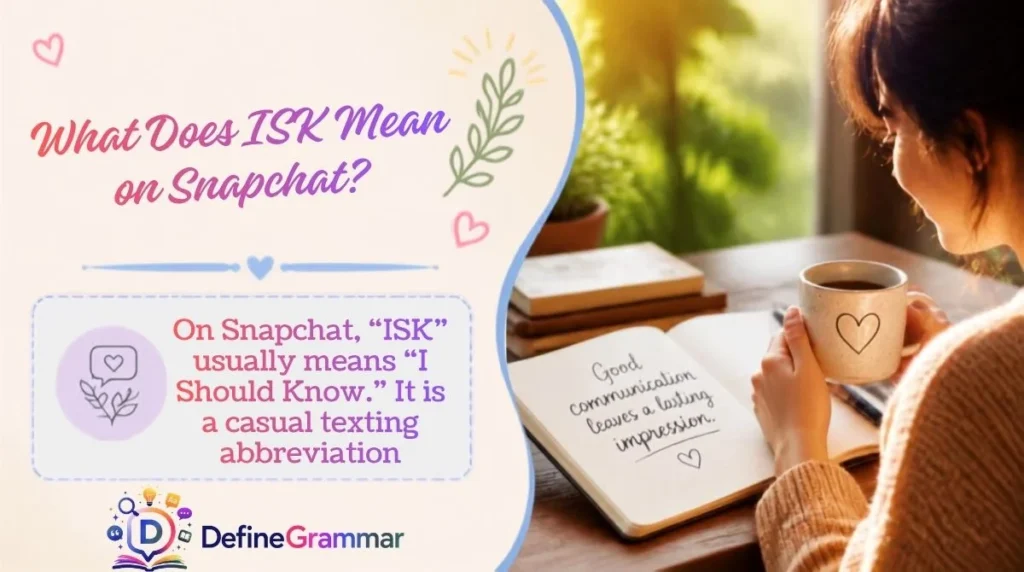
On Snapchat, “ISK” usually means “I Should Know.” It is a casual texting abbreviation people use when they want to say that they are expected to know something, already understand it, or feel that the information should be familiar to them. The exact meaning can depend on the conversation, so it is helpful to look at the surrounding messages.
For example, if someone asks, “Do you know where the party is?” and the reply is “ISK,” the person may mean “I should know” or suggest that they are supposed to know the answer. In some conversations, however, people may use ISK differently or simply make a typo, so context matters.
ISK is more common in quick, informal conversations than in professional writing. On Snapchat, where users often prefer short and fast messages, abbreviations like this can make communication easier.
If you are unsure what someone means by “ISK,” the simplest approach is to check the context or ask, “What do you mean by ISK?” This avoids misunderstanding the message.
ISK Meaning in Text
In text messages, ISK commonly stands for “I Should Know.” It is an informal abbreviation used to express that someone believes they should already know something or that they are expected to have the information.
For example:
Person 1: “When is your sister coming home?”
Person 2: “ISK, probably tonight.”
Here, “ISK” is being used as a shortened form of “I should know,” although the speaker may also be using it loosely to indicate uncertainty or that they are expected to know the answer.
Because texting often involves shortened words and acronyms, the meaning of ISK can vary between people. Unlike more common abbreviations such as “LOL,” “BRB,” or “IDK,” ISK is less universally understood. Therefore, the conversation around it is important when determining its intended meaning.
If you see ISK in a text and the meaning is unclear, do not automatically assume it has only one definition. Consider what the person was discussing, how the abbreviation was used, and whether another meaning makes more sense in that particular conversation.
ISK Meaning in Chat
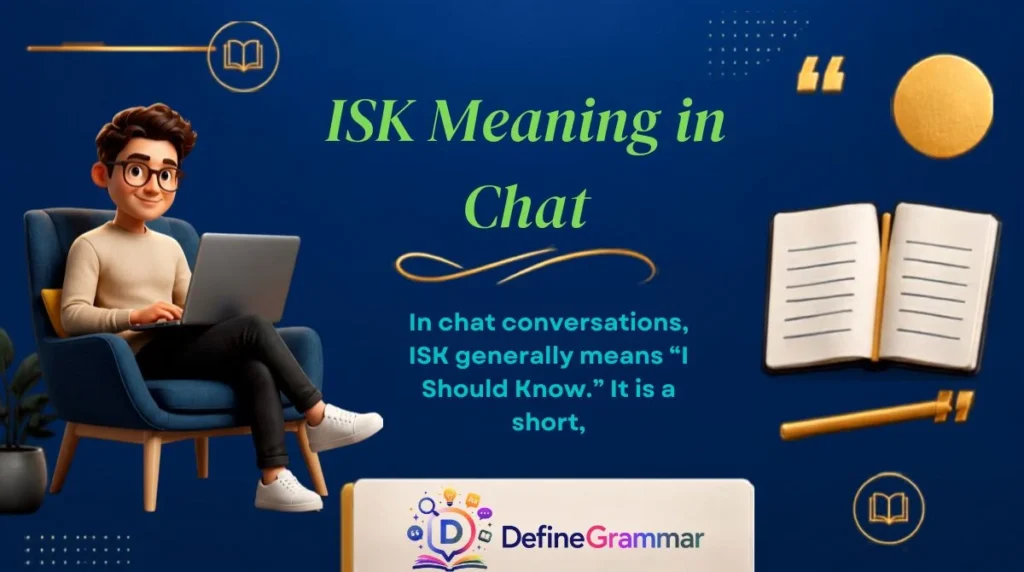
In chat conversations, ISK generally means “I Should Know.” It is a short, informal expression that can be used when someone feels they ought to know the answer to a question or should already have some information.
For instance:
“Do you know what time the meeting starts?”
“ISK, I think it’s at 10.”
In this example, ISK communicates the idea that the person should know the information, even though they may not be completely certain.
The meaning of ISK can change depending on the platform, group, or conversation. People sometimes create their own abbreviations, use slang differently, or make typing mistakes. This is why context is especially important when interpreting short chat terms.
On platforms such as Snapchat, Instagram, WhatsApp, and other messaging apps, users frequently shorten phrases to make conversations quicker. ISK fits this informal style, but it is not normally appropriate for formal emails, academic writing, or professional communication.
When you encounter ISK in a chat, the surrounding message will usually provide the best clue to its intended meaning.
Frequently Asked Questions
What Does “ISK” Mean in Text Slang?
In text slang, “ISK” usually means “I should know” or, depending on context, can be a shortened or mistyped expression. Its exact meaning may change based on the conversation, so checking the surrounding message is important.
What Does ISK Mean in Gen Z?
Among Gen Z texters, “ISK” is not a universally fixed slang term. Some people may use it as an informal abbreviation for “I should know,” while others may use it as a typo or personal shorthand.
What Does ISK Mean From a Girl?
If a girl texts “ISK,” the meaning depends heavily on what she was responding to. It may mean “I should know,” but the tone and previous messages are more useful than the abbreviation alone for understanding her intention.
What Does ISK Mean on Snap?
On Snapchat, “ISK” does not have one official or universal meaning. In casual chats, it can be used as shorthand such as “I should know,” but some users may simply have their own texting style or make a typing mistake.
Final Thoughts
Before you swap ISK for something else, it helps to check how “know” itself — it’s the root of every phrase on this list, formal or casual.
ISK works fine between friends, but it’s not a phrase that travels well into email, school, or work. The fix isn’t complicated: match your words to your audience. Keep ISK and IDK for texts, reach for phrases like “I’m not sure, but I’ll find out” at work, and use precise academic phrasing when you’re writing something formal. Once you have a few go-to alternatives ready, you’ll never be stuck typing slang into the wrong conversation again.

Riaz Ahmad is the founder and writer at DefineGrammar.com, dedicated to simplifying English grammar for students and writers worldwide. With a passion for language, he breaks down complex grammar rules into clear, practical lessons, helping readers write with confidence and clarity every day.