Last updated: 6 September 2026
“Please let me know if you need anything else” is one of the most common phrases in English. You hear it in emails, customer service chats, meetings, shops, and even casual texts.
But saying the same phrase every time can make your writing feel stiff, robotic, or even lazy. Word choice matters — the right phrase can make you sound warm, professional, and confident, while the wrong one can feel cold or dismissive.
- Formal: “Should you require any further assistance, please do not hesitate to reach out.”
- Informal: “Hit me up if you need anything!”
Same idea, completely different feel. Below are 13+ smart alternatives to “please let me know if you need anything else,” with real examples, tone breakdowns, and tips for every situation.
What Does the Phrase Mean?
It’s a polite offer of continued help — a way of saying “I’m here if you have more questions or requests.”
- Grammar form: a polite imperative (“please let me know”) followed by a conditional clause (“if you need anything else”).
- Similar in meaning: “Feel free to ask,” “I am here to help,” “Do not hesitate to reach out.”
- Opposite tone: “That’s all I can do” — closed off and unhelpful.
Example sentences:
- “I have attached the report. Please let me know if you need anything else.”
- “Your order has been placed. Please let me know if you need anything else from our team.”
When to Use It (and When Not To)
| Context | Use It? | Why |
|---|---|---|
| Spoken English | Yes | Natural before wrapping up a conversation |
| Business emails | Yes | Shows availability without being pushy |
| Social media | No | Feels too formal — try “DM me if you need help!” |
| Academic writing | No | Personal offers of help don’t belong here |
| Professional meetings | Yes | Great closer after presenting information |
Is It Polite or Professional?
Yes — it sits in a comfortable middle zone: polite, neutral, and only slightly formal. It’s flexible enough for most situations, though that flexibility can also make it forgettable. For very formal or legal correspondence, a more elevated phrase like “Please do not hesitate to contact me should you require further assistance” works better.
Pros and Cons
Pros: easy for non-native speakers to understand, works in nearly every context, sounds warm and helpful, and is a safe default when you’re unsure of tone.
Cons: overused to the point of feeling generic, can read as a scripted sign-off, and lacks personality in personal or highly formal writing.
Alternatives to “Please Let Me Know If You Need Anything Else”
1. Feel Free to Reach Out Anytime
An open, no-pressure invitation to get in touch whenever needed. Warm without being overly casual.
Example: “I hope this information helps. Feel free to reach out anytime!” Best for: client communication, follow-ups. Tone: friendly, open.
2. Do Not Hesitate to Contact Me
One of the most formal alternatives available. “Do not hesitate” removes any mental barrier to asking for help and carries real professional authority.
Example: “Should you have any questions about the proposal, please do not hesitate to contact me.” Best for: formal emails, business letters, senior contacts. Tone: formal, professional.
3. I Am Here If You Have Any Questions
A simple, personal reassurance that puts you at the center of the offer rather than sounding scripted.
Example: “Please review the attached document. I am here if you have any questions.” Best for: workplace emails, after sharing instructions. Tone: warm, personal.
4. Happy to Help With Anything Further
Cheerful and willing — the word “happy” signals that helping isn’t a burden but something you enjoy.
Example: “I have answered your queries for today. Happy to help with anything further!” Best for: customer service, friendly business emails. Tone: enthusiastic, friendly.
5. Let Me Know If There Is Anything Else I Can Do
A direct, action-focused offer — you’re not just available, you’re actively offering to do something.
Example: “I have processed your request. Let me know if there is anything else I can do.” Best for: after completing a task, customer support. Tone: helpful, neutral.
6. I Remain at Your Disposal
Very formal, high-register English used in official or executive correspondence. “Disposal” here means “service,” not disposal in the everyday sense.
Example: “Should further clarification be required, I remain at your disposal.” Best for: legal letters, executive and diplomatic writing. Tone: very formal, deferential.
7. Feel Free to Follow Up Anytime
Implies an ongoing conversation — ideal when you expect more questions after a proposal or meeting.
Example: “I hope the meeting went well. Feel free to follow up anytime you need support.” Best for: post-meeting emails, established relationships. Tone: friendly, professional.
8. Should You Require Further Assistance, Please Do Not Hesitate to Ask
A polished, double-polite construction that signals high-level fluency and formality.
Example: “Thank you for your enquiry. Should you require further assistance, please do not hesitate to ask.” Best for: corporate and legal correspondence. Tone: formal, polished.
9. Always Happy to Help
Upbeat and generous — “always” signals dependable, ongoing willingness to assist.
Example: “Let me know if you need the file in a different format. Always happy to help!” Best for: quick emails, customer service chats. Tone: enthusiastic, warm.
10. I Am Just an Email Away
A playful, modern way to say you’re easily accessible, without sounding robotic.
Example: “Do not worry about disturbing me — I am just an email away!” Best for: warm professional emails, team communication. Tone: friendly, modern.
11. Please Reach Out If Anything Comes Up
Forward-looking rather than immediate — anticipates future needs without being intrusive.
Example: “I will be out of office Thursday, but please reach out if anything comes up.” Best for: out-of-office replies, project handoffs. Tone: proactive, helpful.
12. Drop Me a Line If You Need Anything
A relaxed idiom (“send me a message”) perfect for colleagues or people you already know well.
Example: “I hope the project goes smoothly! Drop me a line if you need anything.” Best for: informal emails, colleague messages. Tone: casual, friendly.
13. I Would Be Happy to Assist Further
Polite and slightly formal — signals you’ve already helped and are ready to do more, without demanding anything.
Example: “I hope the summary was useful. I would be happy to assist further if needed.” Best for: formal emails, client follow-ups. Tone: polished, warm.
14. My Door Is Always Open
An idiom meaning you’re approachable and available — often used by managers signaling open communication.
Example: “Do not feel like you have to wait — my door is always open.” Best for: workplace leadership, mentoring. Tone: warm, encouraging.
15. Let Me Know If You Need Any Clarification
A targeted offer — useful specifically after sharing complex information or instructions.
Example: “I have outlined the next steps above. Let me know if you need any clarification.” Best for: after detailed reports or technical explanations. Tone: professional, practical.
Mini Dialogue Examples
Formal — Business Email
Manager: I have shared the quarterly report with you. Should you require any clarification on the figures, please do not hesitate to reach out. Employee: Thank you! I’ll review it today and may have a few questions once I go through the data.
Informal — Colleagues
Alex: Hey, I sent over my notes from the meeting! Jordan: Amazing, thanks — I’ll check them out later. Alex: Cool! Just give me a shout if you need anything.
Business Email Example
Subject: Project Files — Sent! Dear Ms. Thompson, please find the project files attached, organized by section for easier navigation. Should you have any questions or require further assistance, please do not hesitate to reach out. I would be happy to schedule a call at your convenience.
Common Mistakes to Avoid
- Using the same phrase in every email until it stops registering — rotate alternatives to keep things fresh.
- Being too casual with formal clients (“Just give me a shout!” to a senior executive can land wrong).
- Being too formal with close colleagues (“I remain at your disposal” with a teammate feels stiff and odd).
- Adding the phrase after a fully resolved request, where it can feel like unnecessary filler.
- Overusing “do not hesitate” — it’s common, but rotating it with fresher options reads better.
- Stacking multiple offers in one email (“Feel free to reach out, let me know, don’t hesitate to ask!”) — one clear offer is enough.
- Mismatching register — “I am at your service” in a text, or “drop me a line” in a legal letter, both feel out of place.
Cultural and Tone Notes
UK English: tends toward restrained phrasing — “please do not hesitate to get in touch” or “feel free to reach out” land well; very enthusiastic phrasing can feel distinctly American.
US English: embraces warmth and positivity — “Happy to help!” and “Reach out anytime” are common, and shorter, punchier closings are preferred.
Casual/Social English: keep it short with friends or close coworkers — “Hit me up,” “Just shout,” or “I’m here if you need me” feel natural; formal phrasing here can seem cold.
Quick Comparison Table
| Phrase | Tone | Best Context |
|---|---|---|
| Do not hesitate to contact me | Formal | Business email, corporate |
| Feel free to reach out anytime | Warm-professional | Client emails, service roles |
| I am here if you have questions | Personal | Follow-up emails, teams |
| Let me know if you need any clarification | Practical | After instructions or reports |
| Always happy to help | Enthusiastic | Customer service, quick replies |
| I remain at your disposal | Very formal | Legal, executive, diplomatic |
| Just give me a shout | Casual | Friends, close colleagues |
Please Let Me Know If You Need Anything Else From My Side
The phrase “Please let me know if you need anything else from my side” is a polite and professional way to tell someone that you are available to provide additional help, information, or documents if required. It reassures the recipient that you are willing to cooperate and support the next steps without sounding pushy.
This expression is commonly used in business emails, job applications, customer service conversations, and project updates. It leaves the conversation open while showing responsibility and professionalism. Whether you are communicating with a client, employer, colleague, or teacher, this phrase demonstrates that you are prepared to assist whenever necessary.
Please Let Me Know If You Require Any Further Information
“Please let me know if you require any further information” is a formal expression used when you have already shared details but are open to answering additional questions. It signals that you are ready to clarify anything that may still be unclear.
This phrase is especially appropriate in professional emails, academic correspondence, legal communication, and customer support. It creates a positive impression by showing transparency and a willingness to help. Many professionals prefer this wording because it sounds courteous while encouraging continued communication.
Should You Need Any Further Information, Please Do Not Hesitate to Contact Me Meaning
The sentence “Should you need any further information, please do not hesitate to contact me” means that the sender warmly invites the recipient to get in touch if they have any questions or need more details. The phrase “do not hesitate” emphasizes that the recipient should feel comfortable reaching out without worrying about causing inconvenience.
This expression is frequently used at the end of formal emails, business proposals, resumes, and application letters. It communicates confidence, professionalism, and a genuine willingness to assist. Although the wording is formal, it remains friendly and respectful, making it suitable for almost any professional setting.
Please Let Us Know If You Need Anything Else
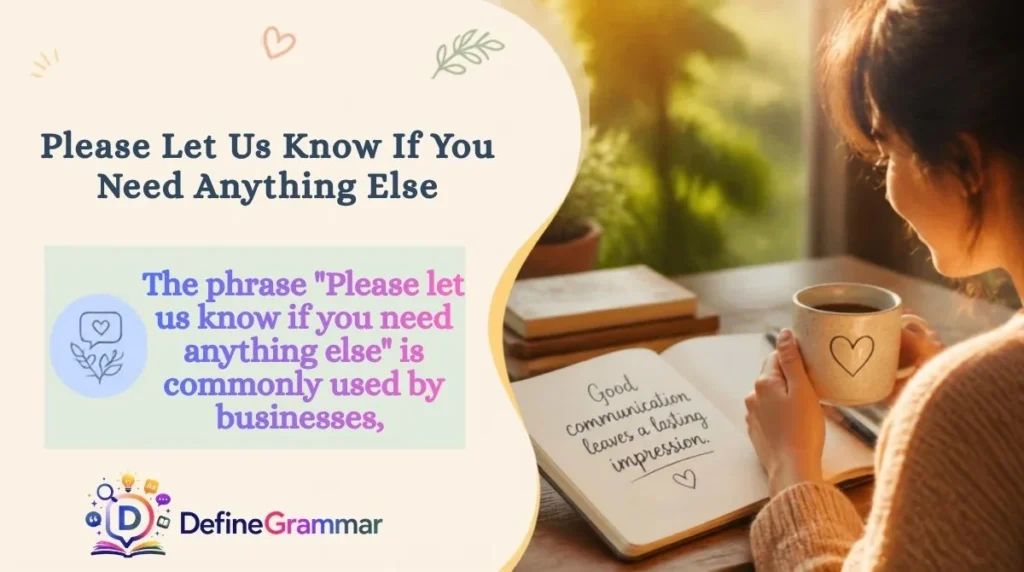
The phrase “Please let us know if you need anything else” is commonly used by businesses, customer support teams, and service providers. Unlike the singular version, this wording represents a group or organization rather than an individual.
It reassures customers or clients that assistance remains available even after the initial request has been completed. The expression helps build trust, improves customer relationships, and leaves a positive final impression. Because it is simple and welcoming, it can also be used in community organizations, schools, and nonprofit communications.
Please Let Me Know If You Need Any Further Assistance
“Please let me know if you need any further assistance” is a professional closing statement that shows your willingness to continue helping after completing a task. It tells the recipient that your support does not end with the current conversation.
This phrase works well in technical support, customer service, workplace emails, and educational settings. It reflects reliability and good communication skills while encouraging the other person to ask for help if new questions arise. Since it is both polite and versatile, it is one of the most frequently used email closings in professional communication.
Please Let Me Know If You Need Any Further Documents
The expression “Please let me know if you need any further documents” is often used when submitting paperwork such as resumes, contracts, invoices, identification, certificates, or application forms. It lets the recipient know that you are prepared to provide any missing files if necessary.
Using this phrase demonstrates organization and cooperation. It can be included in emails to employers, universities, government offices, banks, or clients. By offering additional documents before they are requested, you show professionalism and help avoid unnecessary delays in the process.
Please Let Me Know If There Is Anything Else I Need to Do
“Please let me know if there is anything else I need to do” expresses a willingness to complete any remaining tasks or responsibilities. Instead of offering information, this phrase focuses on asking whether additional actions are required from you.
This wording is particularly useful after submitting an assignment, completing a project, finishing an interview, or sending requested documents. It demonstrates initiative, accountability, and attention to detail. Employers and clients often appreciate this proactive approach because it shows that you want to ensure everything has been handled correctly.
If You Require Any Further Information, I Would Be Happy to Provide It
The phrase “If you require any further information, I would be happy to provide it” is a warm and highly professional way to offer additional details. It combines courtesy with enthusiasm, making it sound more personal than simply saying you are available.
This expression is commonly found in cover letters, formal emails, business proposals, and professional correspondence. It reassures the recipient that you are approachable and willing to answer questions whenever needed. Ending a message with this statement leaves a positive impression because it reflects confidence, helpfulness, and excellent communication etiquette.
Overall, these expressions all serve a similar purpose: they keep communication open, demonstrate professionalism, and show that you are willing to help. Choosing the right phrase depends on the situation, the level of formality, and your relationship with the recipient. Using these polite closings consistently can strengthen professional relationships and make your emails and messages sound more thoughtful, respectful, and effective.
People also search
please let me know if you need anything else email
please let me know if you need anything else sample
please let me know if you require any further information
please let me know if you need any further assistance
please let me know if you need anything else meaning
please let me know if you need anything else reply
should you need any further information, please do not hesitate to contact me meaning
what to say instead of let me know if you need anything
Frequently Asked Questions
How do I say “please let me know if you need anything else” professionally?
A polished way to say this is, “Please let me know if you require any further assistance.” It sounds courteous, professional, and works well in business emails. You can also say, “Feel free to contact me if you need any additional information.”
What to say other than “let me know if you need anything”?
Instead of the common phrase, try “Please don’t hesitate to reach out if I can be of further assistance” or “I’m happy to provide any additional support if needed.” These alternatives sound more polished and leave a positive impression.
How do I professionally say “please let me know”?
For a professional tone, use phrases like “Please keep me informed,” “I would appreciate your feedback,” or “Kindly advise me at your convenience.” These expressions are respectful and appropriate for formal communication.
What is a synonym for “let me know if you need anything”?
Professional alternatives include “Please feel free to reach out if you require further assistance,” “Should you need any additional information, please don’t hesitate to contact me,” and “I’m available if you need any further support.” Each option conveys willingness to help in a courteous manner.
Conclusion
Saying “please let me know if you need anything else” isn’t wrong — it’s kind, clear, and helpful. But repeating the same phrase every time flattens your writing. The alternatives above give you more range to sound warm, professional, or casual depending on who you’re talking to. Word variety signals real communication skill — practice a new phrase each week, and your writing will feel more natural, confident, and effective over time.

Riaz Ahmad is the founder and writer at DefineGrammar.com, dedicated to simplifying English grammar for students and writers worldwide. With a passion for language, he breaks down complex grammar rules into clear, practical lessons, helping readers write with confidence and clarity every day.