Last updated: 3 September, 2026
Every writer hits a wall. You have just made a strong point. Now you need to pivot — to contrast it, qualify it, or draw a conclusion from it. So you type “with that being said” and move on. It works. But it works a little too easily, and that is the problem. Use it once, and it is fine. Use it three times in a single page, and your writing starts to feel lazy.
Knowing other ways to say “with that being said” is not just a vocabulary exercise. It is a communication skill. The right transition phrase changes how confident you sound in an email. It changes how credible you sound in an essay. It changes how professional you come across in a meeting. Word choice is never neutral — it always sends a signal.
Here is a quick example of how a single swap changes everything:
Formal version: “Resources are limited. Nevertheless, the team delivered outstanding results.” Casual version: “It was tough. Still, we made it work.”
Same idea. Completely different energy. That is exactly what this guide will help you master.
What Does “With That Being Said” Mean?
“With that being said” is a transitional phrase. It tells your reader or listener: “I have just made a point — now here comes something that contrasts, qualifies, or concludes it.“ It signals a pivot. It is the verbal equivalent of turning a corner in a conversation.
Grammar Form: Participial phrase / transitional discourse marker
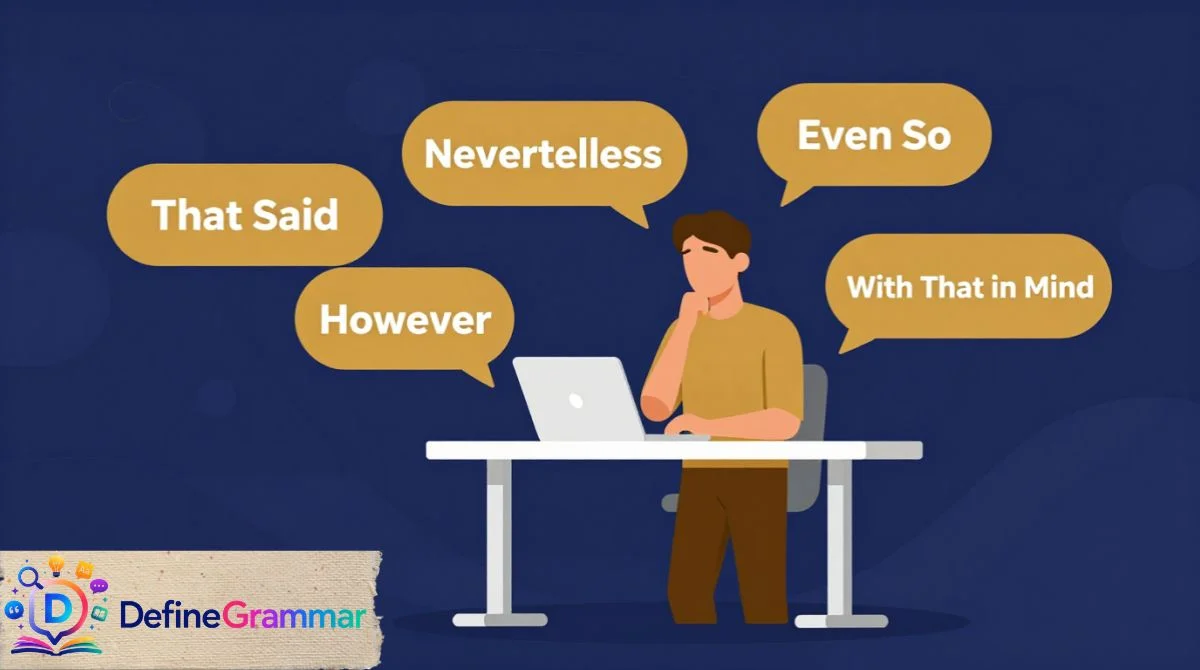
Synonyms in feel: That said, nevertheless, however, even so, all the same
Opposite tone words: Furthermore, additionally, moreover, also, in addition — these phrases build and add. This phrase pivots and contrasts.
Sample Sentences:
- “The new system has a steep learning curve. With that being said, the long-term efficiency gains are impossible to ignore.”
- “He had never managed a team before. With that being said, his leadership instincts were remarkably strong from day one.”
When to Use “With That Being Said”
Spoken English It sounds completely natural in everyday speech. Native speakers use it constantly when wrapping up a point, softening a contrast, or pivoting in casual conversation. It has a relaxed, unhurried quality that works well verbally.
Business English It fits comfortably in presentations, team meetings, and internal discussions. The key is restraint — once or twice in a meeting sounds natural. More than that sounds repetitive and unfocused.
Emails and Messages It works in semi-formal emails and casual team threads. For formal client correspondence or executive-level communication, “That said” or “Nevertheless” are cleaner and stronger choices.
Social Media Too long for most platforms. On Twitter, Instagram, or LinkedIn captions, reach for something punchy: “Still,” “Even so,” or “That said” hit harder in tight spaces.
Academic Writing Avoid it entirely in essays and research papers. Academic writing demands a higher register. Use “Nevertheless,” “Nonetheless,” or “However” and you will sound far more credible.
Professional Meetings It is a natural fit when pivoting between discussion points, softening critical feedback, or moving from problem analysis toward a proposed solution.
Is “With That Being Said” Polite or Professional?
Polite: Yes. It never dismisses what came before — it acknowledges it before pivoting. That quality makes it feel respectful and balanced.
Neutral: Yes. It carries no strong emotion. It is neither enthusiastic nor negative on its own.
Strong: No. It does not project authority or decisiveness. It is a soft landing, not a firm stance.
Soft: It leans soft. It eases into contrast rather than challenging anything directly.
Formal vs Informal: It sits in the middle ground. For board-level memos, academic papers, or legal documents, the register is too casual. In a team email or a client update, it lands perfectly.
Etiquette Tip: Use it comfortably in workplace conversations, semi-formal emails, and team presentations. Avoid it in academic submissions, legal briefs, and formal executive reports — those contexts demand sharper, higher-register connectors.
Pros and Cons of Using “With That Being Said”
✔ Pros:
- Natural and instantly understood at every English level
- Flows smoothly in both spoken and written communication
- Softens contrast without sounding aggressive or dismissive
- Works across a wide range of personal and professional contexts
- Recognized and accepted across all English-speaking cultures and regions
✘ Cons:
- Severely overused — loses its effect when repeated even twice
- Too informal for academic essays, legal writing, and formal reports
- Adds unnecessary words where a single connector would do the job better
- Can read as conversational filler in polished professional writing
- Lacks the authority and precision that high-stakes communication requires
Fully Expanded Alternatives
That Said
Meaning: A short, confident pivot from one idea to the next.
Explanation: This is the single most useful replacement you will find on this entire list. It does exactly what the original phrase does — signals a contrast or conclusion — but with half the words and twice the confidence. Native speakers use it constantly in emails, presentations, podcasts, and everyday speech. It never sounds forced, never sounds stiff, and works in almost every context imaginable. If you only bookmark one phrase from this article, make it this one.
Grammar Note: Participial phrase / discourse marker
Example Sentence: “The onboarding process was longer than expected. That said, every new hire this quarter rated the experience a nine or ten out of ten.”
Best Use: Professional emails, team meetings, casual speech, blog writing, business reports, client presentations
Worst Use: Formal legal documents or high-stakes governmental writing where a stronger connector is required
Tone: Neutral / Professional
Level: Beginner
Similarity Score: 9/10
Replaceability Tip: Use this as your everyday default. When the original phrase feels too long or too heavy for the context, “That said” almost always fits perfectly.
Nevertheless
Meaning: In spite of what was just said, the following point stands firm.
Explanation: This is the phrase you reach for when you want your writing to carry weight. “Nevertheless” does not soften anything — it confirms that the previous point has been acknowledged and the conclusion stands regardless. It signals authority, resolve, and intellectual confidence. Business leaders use it. Academics use it. Lawyers use it. That is the company it keeps.
Grammar Note: Conjunctive adverb
Example Sentence: “The economic conditions were some of the most challenging the company had ever faced. Nevertheless, they posted record profits for the third consecutive year.”
Best Use: Academic essays, formal business reports, executive communication, official presentations, legal documents
Worst Use: Text messages, informal emails, social media captions — it sounds overcorrected and stiff in casual settings
Tone: Formal / Strong / Authoritative
Level: Intermediate
Similarity Score: 8/10
Replaceability Tip: Reach for this whenever you need to sound confident and authoritative after presenting a significant challenge, setback, or objection.
However
Meaning: In contrast to what came before, here is another important point.
Explanation: The most versatile transition word in English. It works in virtually every register — formal, informal, academic, conversational — without sounding out of place. The only real risk with “however” is overuse. When it appears four or five times in a single document, it stops functioning and becomes invisible background noise.
Grammar Note: Conjunctive adverb
Example Sentence: “The initial proposal came in significantly over the approved budget. However, the strategic value it represented made it worth a second, closer look.”
Best Use: Every context — academic writing, professional emails, business reports, casual conversation, social media
Worst Use: When used repeatedly in one document or conversation — use it once or twice and then rotate to other alternatives
Tone: Neutral
Level: Beginner
Similarity Score: 7/10
Replaceability Tip: When nothing else fits or when you are unsure which alternative to choose, “However” is always a safe and reliable default.
Even So
Meaning: Despite that specific fact, this is still true — and it matters.
Explanation: There is something warm and slightly resilient about “even so.” It acknowledges a real difficulty — genuinely, not dismissively — and then shows that something happened anyway. It carries a quiet emotional strength. Readers feel it. It is the kind of phrase that makes a story feel human.
Grammar Note: Adverbial phrase
Example Sentence: “The marathon training was brutal on her body and took every spare hour she had. Even so, she crossed the finish line smiling and immediately signed up for the next one.”
Best Use: Storytelling, personal essays, spoken English, motivational writing, friendly emails, persuasive content
Worst Use: Legal documents, formal government communication, highly technical reports
Tone: Soft / Warm / Resilient
Level: Beginner
Similarity Score: 8/10
Replaceability Tip: Use when you want the reader to genuinely feel the difficulty of the situation before you show that it was overcome or did not change the outcome.
Nonetheless
Meaning: Despite that, the situation or truth still stands exactly as stated.
Explanation: Think of “nonetheless” as “nevertheless” with a slightly softer edge. Both are formal. Both are authoritative. But “nonetheless” appears more naturally in written English — in reports, academic papers, formal correspondence — while “nevertheless” works equally well in formal speech. Elegant, controlled, and never aggressive.
Grammar Note: Conjunctive adverb
Example Sentence: “The public response in the first weeks was far more skeptical than the team had anticipated. Nonetheless, the campaign continued, adapted, and ultimately delivered results that exceeded every original benchmark.”
Best Use: Academic papers, formal business writing, professional correspondence, legal briefs, research writing
Worst Use: Casual conversation, text messaging, social media posts
Tone: Formal / Neutral / Measured
Level: Intermediate
Similarity Score: 8/10
Replaceability Tip: A strong swap when you want to avoid repeating “nevertheless” in the same document without losing any of its formal weight.
Having Said That
Meaning: While genuinely acknowledging what I just told you, here is an equally important counterpoint.
Explanation: This phrase has a fair-minded, balanced quality that the original phrase sometimes lacks. It gives the impression that the speaker has thought carefully about both sides before speaking. Common in professional British and American English. Very natural in meetings, presentations, and semi-formal emails.
Grammar Note: Participial phrase
Example Sentence: “The restructuring created a lot of uncertainty across the team, and that was genuinely difficult for everyone. Having said that, the clarity and direction it has given us heading into Q2 has been transformative.”
Best Use: Workplace conversations, professional emails, client presentations, performance reviews, business meetings
Worst Use: Formal academic writing — slightly too conversational for scholarly papers
Tone: Balanced / Professional / Warm
Level: Intermediate
Similarity Score: 9/10
Replaceability Tip: Ideal when you want to be seen as honest, fair, and balanced — giving real credit to the downside before presenting the positive.
Be That as It May
Meaning: Whatever the circumstances or objections may be, what follows remains true.
Explanation: Formal, deliberate, and carrying the weight of centuries of usage. It signals that the speaker has heard and considered every objection and is choosing to stand firm regardless. It commands attention. It does not apologize. It has a slightly theatrical quality that can be very effective in speeches and formal writing — but it sounds archaic in everyday conversation.
Grammar Note: Fixed idiomatic phrase / formal connector
Example Sentence: “The financial forecast for the sector was among the worst analysts had published in over a decade. Be that as it may, the founders committed to their vision and launched on schedule.”
Best Use: Formal speeches, persuasive essays, legal arguments, authoritative written communication
Worst Use: Casual emails, daily conversation, team messaging — sounds outdated and unnecessarily heavy
Tone: Formal / Strong / Dramatic
Level: Advanced
Similarity Score: 7/10
Replaceability Tip: Choose this when you want to sound commanding and firm in a formal context. Never use it casually.
Still
Meaning: Even given all of that, this remains true.
Explanation: One word. Zero filler. Maximum efficiency. “Still” carries genuine emotional punch despite its size. It is the most honest-sounding transition on this list because it strips away all the padding and just states the contrast plainly. Readers feel the weight of it precisely because it is so small and unadorned.
Grammar Note: Adverb / discourse marker
Example Sentence: “The funding fell through in the final week. Still, the team shipped the product on time and with every feature intact.”
Best Use: Casual and personal writing, social media, text messages, storytelling, friendly emails, spoken conversation
Worst Use: Formal academic essays opened with this word — it reads as too informal for scholarly writing
Tone: Casual / Honest / Direct
Level: Beginner
Similarity Score: 7/10
Replaceability Tip: When you want your writing to feel human, unpolished in the best way, and punchy — one word is all you need.
All the Same
Meaning: Despite everything, the outcome or feeling does not change.
Explanation: Carries a gently resigned, quietly stubborn quality. The speaker has considered the full picture and still arrives at the same place. Very common in British English. Works particularly well in storytelling when patience, persistence, or quiet loyalty is the emotional thread of the story.
Grammar Note: Adverbial phrase
Example Sentence: “Everyone told him the restaurant would never work in that location. All the same, he signed the lease, opened the doors, and within six months had a waiting list every weekend.”
Best Use: Conversational English, storytelling, character writing, British English contexts, personal essays
Worst Use: Formal business reports, executive emails, academic papers
Tone: Soft / Neutral / Quietly resolute
Level: Intermediate
Similarity Score: 7/10
Replaceability Tip: Choose this when you want to show that someone held firm — quietly, without drama — in the face of doubt or difficulty.
In Any Case
Meaning: Regardless of the details just discussed, this is what actually matters now.
Explanation: Slightly dismissive in a purposeful way. It signals that the previous discussion, however valid, does not change the direction or the conclusion. Useful for cutting through lengthy conversations and refocusing everyone on the essential point or the next concrete step.
Grammar Note: Prepositional phrase / discourse marker
Example Sentence: “There were at least five different approaches suggested across two long meetings. In any case, we need one clear decision made and communicated to the client before noon tomorrow.”
Best Use: Business meetings, formal emails, decision-making discussions, project management
Worst Use: Emotionally sensitive conversations — can feel cold and dismissive of real concerns
Tone: Neutral / Direct / Purposefully dismissive
Level: Intermediate
Similarity Score: 6/10
Replaceability Tip: Use to refocus a drifting conversation on the single most important conclusion or next step.
Regardless
Meaning: No matter what was raised or discussed, this is the position.
Explanation: Hard, firm, and completely decisive. “Regardless” does not soften anything. It tells the reader or listener that the decision has been made and that it will not change based on anything that came before. Powerful in leadership and decision-making contexts. Potentially blunt or cold in personal ones.
Grammar Note: Adverb
Example Sentence: “The legal team flagged several significant risks with the structure of the deal. Regardless, the partnership was signed the following morning.”
Best Use: Leadership communication, executive decision emails, business announcements, policy writing
Worst Use: Emotional or personal conversations — can sound cold, stubborn, or dismissive of real concerns
Tone: Strong / Firm / Decisive
Level: Beginner
Similarity Score: 6/10
Replaceability Tip: Only use this when genuine decisiveness is the core message. If empathy or openness is needed, choose something softer.
Despite That
Meaning: Even though that is true, this other thing is also the case.
Explanation: Clean, efficient, and professional. No drama, no filler. It does exactly one job — signals that a real challenge has been acknowledged and a positive outcome or conclusion follows anyway. Works especially well in business writing where you need to address a problem and immediately pivot to a solution.
Grammar Note: Prepositional phrase
Example Sentence: “The supply chain disruptions were more severe and longer-lasting than anyone had modeled. Despite that, the company fulfilled 97% of all customer orders within the promised timeframe.”
Best Use: Business emails, professional reports, formal presentations, client-facing communication
Worst Use: When “that” is vague or ambiguous — always make the specific contrast clear and explicit
Tone: Professional / Neutral / Confident
Level: Beginner
Similarity Score: 8/10
Replaceability Tip: A reliable, clean swap in any professional or business context where you need to pivot from a challenge to a result without dwelling on the problem.
On the Other Hand
Meaning: Looking at the alternative or contrasting perspective, here is what is equally true.
Explanation: The gold standard for two-sided, balanced discussion. It tells the reader that both sides of an argument are being given equal, fair consideration. Common in academic essays, analytical business writing, and any discussion that requires intellectual balance and objectivity.
Grammar Note: Prepositional phrase / discourse marker
Example Sentence: “Expanding into the new market would significantly increase revenue potential and brand visibility. On the other hand, the operational complexity and regulatory risk could stretch the team beyond its current capacity.”
Best Use: Academic essays, business strategy discussions, comparison writing, pros-and-cons emails, balanced presentations
Worst Use: When the two ideas actually agree or complement each other — there must be a genuine contrast for this phrase to make sense
Tone: Balanced / Analytical / Fair
Level: Beginner
Similarity Score: 6/10
Replaceability Tip: Perfect any time you are presenting two genuinely competing ideas, perspectives, or outcomes with equal weight and fairness.
At the Same Time
Meaning: While one thing is true, another equally valid thing also exists alongside it.
Explanation: This phrase does not cancel one idea with another — it holds both at once. It is for moments of genuine complexity, where two things are simultaneously true and both matter. Thoughtful, honest, and professionally appropriate in almost any setting.
Grammar Note: Adverbial phrase
Example Sentence: “We are committed to scaling the product as quickly as the market allows. At the same time, we have a non-negotiable responsibility to maintain the trust and confidence of our existing customer base.”
Best Use: Business planning, strategy emails, leadership communication, management discussions
Worst Use: When the two ideas are genuinely contradictory — use “however” or “nevertheless” for true sharp contrasts
Tone: Thoughtful / Balanced / Professional
Level: Beginner
Similarity Score: 7/10
Replaceability Tip: Use when you need to honor two competing priorities simultaneously rather than dismissing one in favor of the other.
With All That in Mind
Meaning: Having considered every point just discussed, here is the conclusion or recommended next step.
Explanation: The most deliberate and complete replacement for the original phrase on this list. It signals that the speaker has absorbed, weighed, and synthesized everything — and is now ready to deliver a final point, recommendation, or decision. Common in formal meetings, executive communication, and strategic presentations.
Grammar Note: Prepositional phrase
Example Sentence: “We have reviewed the risk profile, the budget constraints, the market data, and the client’s stated expectations in careful detail. With all that in mind, here is the approach we are recommending.”
Best Use: Formal meetings, executive presentations, strategy emails, proposal documents, high-stakes business communication
Worst Use: Casual social conversation or everyday emails — sounds overly deliberate and stiff
Tone: Professional / Deliberate / Thoughtful
Level: Intermediate
Similarity Score: 9/10
Replaceability Tip: Your strongest formal swap when you are drawing a conclusion from multiple preceding points in a meeting or strategic document.
Notwithstanding
Meaning: In spite of; without being altered or diminished by what was just stated.
Explanation: Carries clear legal and formal governmental associations. This word says firmly: “none of what came before changes this.” It is not for everyday use. It belongs in official documents, formal arguments, and institutional writing where authority and precision must be unmistakable.
Grammar Note: Preposition / formal adverb
Example Sentence: “The contractual delays and cost overruns notwithstanding, the completed infrastructure project met every original quality specification without exception.”
Best Use: Legal documents, formal government reports, academic writing, official proposals, institutional communication
Worst Use: Any casual or semi-formal context — sounds displaced and unnecessarily heavy outside formal writing
Tone: Very Formal / Authoritative / Commanding
Level: Advanced
Similarity Score: 6/10
Replaceability Tip: Reserve this exclusively for legal, governmental, or high-level academic writing. Never use it casually.
That Being the Case
Meaning: Since that is the established situation, here is what logically follows.
Explanation: Methodical and clear. The speaker is drawing a logical conclusion directly from what was just established. It shows cause-and-effect reasoning without any emotional color — neither warm nor cold, just precise and professional.
Grammar Note: Participial clause
Example Sentence: “The contractual deadline is fixed and cannot be extended under any circumstances. That being the case, every outstanding design decision must be finalized before close of business Wednesday.”
Best Use: Professional meetings, business emails, project planning documents, contract discussions
Worst Use: Emotional or personal conversations — too clinical and detached for human-centered communication
Tone: Logical / Professional / Precise
Level: Intermediate
Similarity Score: 9/10
Replaceability Tip: Use in professional and planning contexts where showing your logical reasoning clearly is more important than warmth.
All Things Considered
Meaning: After honestly weighing every relevant factor, here is the final and complete conclusion.
Explanation: This phrase signals a definitive assessment. It tells the reader that the speaker has not rushed — they have looked at all angles, all factors, all evidence — and is now delivering a final, balanced judgment. Common at the end of evaluations, reviews, and project retrospectives.
Grammar Note: Absolute phrase / discourse marker
Example Sentence: “There were technical delays, a mid-project scope change, and three weeks of unexpected disruption. All things considered, the final delivery was genuinely impressive and the client was delighted.”
Best Use: Performance reviews, project retrospectives, annual summaries, evaluation reports, end-of-discussion summaries
Worst Use: Mid-paragraph or mid-conversation — it signals finality and belongs near a conclusion, not in the middle of an argument
Tone: Reflective / Balanced / Conclusive
Level: Intermediate
Similarity Score: 7/10
Replaceability Tip: Best for wrapping up a discussion with a final, balanced verdict — not for mid-paragraph transitions.
After All
Meaning: Considering the full context and what I know, this conclusion makes complete sense.
Explanation: Slightly knowing and persuasive. It gently suggests that the outcome was perhaps inevitable or obvious in hindsight. Sometimes reminds the reader of something they may have overlooked. Warm and conversational in tone, with a light persuasive edge that works well in motivational or explanatory writing.
Grammar Note: Adverbial phrase
Example Sentence: “It makes sense that she was chosen to lead the expansion. After all, she had spent six years building exactly the kind of relationships the project would require.”
Best Use: Conversational English, explanatory writing, motivational content, friendly emails, storytelling
Worst Use: Formal reports or academic papers — can sound too casual or slightly presumptuous for scholarly work
Tone: Warm / Conversational / Gently persuasive
Level: Beginner
Similarity Score: 6/10
Replaceability Tip: Use when you want to remind your reader that a conclusion makes obvious, logical sense given everything that led up to it.
Having Acknowledged That
Meaning: Now that I have given genuine, fair weight to this point, here is what follows.
Explanation: Highly formal and deliberately intellectual. Used in academic writing and formal professional documents to signal that the writer has honestly engaged with the opposing view before moving forward. It demonstrates intellectual integrity and fair argumentation.
Grammar Note: Participial phrase / formal academic connector
Example Sentence: “Having acknowledged that staffing costs have risen sharply across all departments, leadership must now identify specific, measurable ways to protect the organization’s overall financial health.”
Best Use: Academic essays, formal business reports, research writing, structured professional arguments
Worst Use: Everyday emails or spoken conversation — sounds stiff and overly constructed
Tone: Formal / Intellectual / Respectful
Level: Advanced
Similarity Score: 8/10
Replaceability Tip: Use in academic writing when you need to concede a valid opposing point with intellectual honesty before building your own argument.
Setting That Aside
Meaning: Deliberately leaving that point behind to focus on something more productive or relevant.
Explanation: A conscious, intentional redirection. The speaker is choosing to stop discussing the previous point and move forward. It works well in meetings when conversations drift into tangents or unproductive territory. It can sound slightly dismissive if overused or if the issue being set aside genuinely matters to someone in the room.
Grammar Note: Participial phrase
Example Sentence: “Setting that aside for now, let’s spend the rest of this meeting focused on the three things we can actually control before the end of the quarter.”
Best Use: Business meetings, team planning sessions, leadership communication, project management discussions
Worst Use: When the point being set aside is genuinely important and unresolved — risks appearing dismissive or avoidant
Tone: Direct / Professional / Action-oriented
Level: Intermediate
Similarity Score: 7/10
Replaceability Tip: Most effective when a meeting or discussion is losing focus and you need to redirect without creating conflict.
In Light of That
Meaning: Given what was just shared or revealed, here is the appropriate response or conclusion.
Explanation: Suggests that new information or evidence has clarified the path forward. It connects cause to effect in a professional, logical, and confident way. Common in business communication, government language, and formal reports where clear decision-making is being documented.
Grammar Note: Prepositional phrase
Example Sentence: “Customer satisfaction scores have declined for the third quarter in a row. In light of that, we are launching a full service review and realigning the support team’s priorities immediately.”
Best Use: Business emails, formal meetings, decision documentation, executive memos, client communications
Worst Use: Personal or emotionally sensitive conversations — sounds too analytical and detached
Tone: Professional / Analytical / Decisive
Level: Intermediate
Similarity Score: 8/10
Replaceability Tip: Use in business writing when you want to show a clear, direct, and logical connection between new information and your next action.
Taking That into Account
Meaning: Actively using what was just said to inform the decision or recommendation that follows.
Explanation: Shows methodical thinking. The speaker is not dismissing the previous point — they are incorporating it into their conclusion. This phrase makes your reasoning visible, which is exactly what readers and listeners in analytical and strategic conversations want to see.
Grammar Note: Participial phrase
Example Sentence: “The market data indicates higher-than-expected price sensitivity among our core customer segment. Taking that into account, we are proposing a revised pricing structure for the Q3 launch.”
Best Use: Business strategy documents, financial analysis, planning emails, analytical presentations
Worst Use: Emotional or personal conversations — sounds too clinical and calculated for sensitive situations
Tone: Analytical / Professional / Transparent
Level: Intermediate
Similarity Score: 9/10
Replaceability Tip: Use in strategic or data-driven writing where making your reasoning transparent and methodical is important.
Even Then
Meaning: Even under those specific conditions or with those resources, the result still holds.
Explanation: Small phrase. Big emotional weight. “Even then” signals that something is true even in the most challenging or unlikely scenario — and that makes it compelling. It creates tension and then resolves it. Common in performance discussions, narrative writing, and persuasive essays.
Grammar Note: Adverbial phrase
Example Sentence: “The company provided him with an experienced mentor, an extended timeline, and every tool available. Even then, performance never improved to an acceptable level.”
Best Use: Performance writing, storytelling, persuasive arguments, evaluative reports
Worst Use: When the contrast is not genuinely dramatic — the phrase raises expectations, so the situation must justify them
Tone: Emphatic / Serious / Quietly dramatic
Level: Intermediate
Similarity Score: 7/10
Replaceability Tip: Use when you want to show that even extraordinary support, time, or effort did not change the outcome — and that matters.
Despite This
Meaning: Even though this specific situation is the case, something else also remains true.
Explanation: Efficient and professional. Nearly identical to “despite that” but slightly more immediate. “This” suggests the obstacle is present and close rather than already in the past. Works well in both formal writing and professional spoken communication.
Grammar Note: Prepositional phrase
Example Sentence: “User feedback across every testing group was consistently divided and difficult to synthesize. Despite this, the product team launched on schedule and the first-week adoption rate exceeded all projections.”
Best Use: Business writing, formal emails, persuasive essays, professional presentations
Worst Use: Academic essays where “nevertheless” or “nonetheless” are the stronger and more appropriate choice
Tone: Professional / Neutral / Clean
Level: Beginner
Similarity Score: 8/10
Replaceability Tip: A fast, clean swap in most professional writing contexts when you need contrast without extra length.
Albeit
Meaning: Although or even though — used to qualify a claim from within a sentence.
Explanation: One of the most efficient words in formal English. “Albeit” does not start a sentence — it lives inside one, immediately qualifying the idea before it. It adds sophistication and precision with no extra words, no added sentences. Widely used in formal and literary writing by confident, experienced writers.
Grammar Note: Conjunction (used mid-sentence, never as a sentence-opener)
Example Sentence: “The project was completed on time, albeit with considerably more personal sacrifice from the team than anyone had originally anticipated or planned for.”
Best Use: Formal writing, academic essays, professional reports, legal documents, literary and editorial writing
Worst Use: Casual conversation or at the start of a sentence — unnatural in everyday spoken English
Tone: Formal / Refined / Precise
Level: Advanced
Similarity Score: 5/10
Replaceability Tip: Use mid-sentence when you want to add a brief, precise qualification elegantly without breaking the flow of your writing.
That Notwithstanding
Meaning: Despite everything just stated, this remains true and significant.
Explanation: Formal, weighty, and carrying a slightly archaic authority. This is institutional language. It appears in legal rulings, governmental decisions, formal academic discourse, and official speeches. It does not belong in everyday communication under any circumstances — but in the right context, it is exactly right.
Grammar Note: Participial clause / formal connector
Example Sentence: “There were well-reasoned, substantive objections raised by a significant number of committee members. That notwithstanding, the resolution passed with a clear and decisive majority.”
Best Use: Legal writing, formal governance documents, academic papers, official speeches and institutional statements
Worst Use: Any informal or semi-formal context — sounds completely out of place
Tone: Very Formal / Institutional / Commanding
Level: Advanced
Similarity Score: 7/10
Replaceability Tip: Reserve this exclusively for legal, governmental, or high-level academic writing where institutional authority matters above all else.
Moving Forward
Meaning: Let us stop looking at what happened and focus entirely on what comes next.
Explanation: One of the most common phrases in business communication today. It is optimistic, action-oriented, and future-focused. It signals clearly that the difficult topic or challenging period has been addressed and the team is now pivoting toward solutions and momentum. Widely used in leadership communication after acknowledging problems.
Grammar Note: Participial phrase / business idiom
Example Sentence: “We understand the challenges we faced and have been fully transparent about what went wrong. Moving forward, the entire organization is aligned on our recovery strategy and committed to executing it.”
Best Use: Business meetings, leadership emails, team retrospectives, strategic planning, annual reviews
Worst Use: When used to bypass accountability or rush past genuinely unresolved issues — risks appearing evasive or dismissive
Tone: Optimistic / Professional / Forward-focused
Level: Beginner
Similarity Score: 6/10
Replaceability Tip: Ideal when a problem has been genuinely addressed and you need to cleanly redirect all energy toward solutions and the next chapter.
With That in Mind
Meaning: Keeping that specific point clearly in your thinking, here is the conclusion or proposal that follows.
Explanation: The closest alternative to the original phrase on this entire list — almost word-for-word equivalent in meaning and tone but noticeably shorter and cleaner. It signals that the previous point has been heard, absorbed, and used to shape what comes next. Shows responsiveness and professional thoughtfulness.
Grammar Note: Prepositional phrase
Example Sentence: “The client has made it abundantly clear that responsiveness and communication speed are their absolute top priorities. With that in mind, we are proposing a revised engagement model built entirely around real-time updates and weekly check-ins.”
Best Use: Business writing, client emails, professional meetings, proposal documents, strategy communication
Worst Use: Formal academic writing — reads slightly too conversational for scholarly registers
Tone: Professional / Considerate / Clear
Level: Beginner
Similarity Score: 10/10
Replaceability Tip: This is your most direct, plug-in swap. Identical in meaning and tone to the original — just shorter, cleaner, and more professional in written form.
In Spite of That
Meaning: Even though that is acknowledged and true, this other thing still stands.
Explanation: More emphatic than “despite that.” It highlights a genuine tension between two realities — it does not rush past it. The speaker is sitting with the difficulty before showing what happened next. Readers feel that tension, and it makes the contrast meaningful rather than mechanical.
Grammar Note: Prepositional phrase
Example Sentence: “The critical response to the debut novel was almost universally dismissive. In spite of that, it found its readers through word of mouth and eventually sold over two million copies worldwide.”
Best Use: Storytelling, persuasive essays, motivational writing, business content, personal narratives
Worst Use: When you need a calm, no-drama neutral transition — this phrase carries real emotional weight that must be earned
Tone: Empathetic / Firm / Emotionally resonant
Level: Beginner
Similarity Score: 8/10
Replaceability Tip: Use when the contrast between obstacle and outcome is genuinely significant and you want the reader to feel both sides of it.
That Granted
Meaning: Accepting that as fully legitimate and true, here is the counterpoint or conclusion.
Explanation: Compact and philosophical. It concedes the previous point completely and fairly — and then moves on to challenge or qualify it from a different angle. More at home in structured academic debates and formal argumentation than in everyday professional writing.
Grammar Note: Participial clause
Example Sentence: “The operational savings from the restructuring are clearly documented and significant. That granted, the impact on team morale and institutional knowledge must also be factored into any honest assessment.”
Best Use: Formal debates, academic essays, policy discussions, structured argumentation, think-pieces
Worst Use: Most professional emails and everyday workplace conversations — sounds stiff and unnecessarily formal
Tone: Formal / Analytical / Intellectually balanced
Level: Advanced
Similarity Score: 7/10
Replaceability Tip: Use in formal arguments when you want to concede a legitimate opposing point completely before presenting your own counter-position.
Even With That
Meaning: Even when that specific thing is taken into account, the conclusion or outcome stays the same.
Explanation: Casual, honest, and immediately understandable. It acknowledges a challenge or complication without dismissing it, and then confirms that the conclusion still stands. Natural in everyday speech and in friendly written communication where warmth matters more than formality.
Grammar Note: Adverbial phrase
Example Sentence: “The two-hour commute each way is genuinely significant. Even with that, this role is absolutely the right move for where I want to be in five years.”
Best Use: Casual spoken English, friendly emails, text messages, personal writing, informal professional conversation
Worst Use: Formal reports, academic essays, legal or governmental documents
Tone: Casual / Honest / Warm
Level: Beginner
Similarity Score: 8/10
Replaceability Tip: A natural, unforced alternative for everyday conversations where the original phrase feels a little too long or a little too formal for the moment.
Mini Dialogue Examples
Formal Dialogue — Year-End Performance Review
Director: “I want to be direct with you — your output metrics have been below expectations for two consecutive quarters, and we need to address that clearly.”
Senior Analyst: “I understand completely, and I appreciate you being direct. That said, I successfully led all four of our flagship client accounts through the merger transition, and every single one renewed their contract for next year.”
Director: “That context is genuinely important, and it matters. With that in mind, we will make sure both the quantitative and qualitative dimensions are fully reflected in your final evaluation.”
Informal Dialogue — Two Friends Discussing a Career Decision
Priya: “Honestly, the commute to that new job sounds absolutely brutal. Two hours each way every single day.”
James: “I know. Even so, the role itself is exactly what I have been working toward for the past four years. I would be ridiculous to turn it down over a commute.”
Priya: “Fair point. Still, get a good podcast playlist sorted before you start. Trust me.”
Business Email Example
Subject: Q2 Timeline — Update and Next Steps
Dear Ms. Nakamura,
Thank you for reaching out with your concerns about the delivery delays we experienced in the first half of the quarter. We completely understand the operational impact this has had on your team’s planning cycle and take it seriously. Nevertheless, I am pleased to confirm that our team has fully recovered the lost time and we are now on track to meet the original delivery date without any further adjustment.
In light of that, I would like to propose a brief thirty-minute call this Thursday at 10 AM to walk you through the revised schedule in detail and address any remaining questions your team may have.
Best regards, Daniel Okafor Senior Project Manager
Mistakes to Avoid
Repeating the same phrase more than once in a short document. Whether it is the original phrase or one of its alternatives, repetition drains impact. Rotate between at least two or three options within the same piece of writing.
Using it in academic writing without thinking. The phrase drops the register of an essay immediately. Academic writing expects “Nevertheless,” “Nonetheless,” or “However.” Make that swap every single time.
Using it as an additive connector. This phrase signals contrast and pivot — not addition. If your next sentence builds on the previous one rather than contrasting it, reach for “Furthermore” or “In addition” instead.
Using the phrase when there is no real contrast. The pivot must be real. If both ideas point in the same direction, this phrase creates confusion. There has to be a genuine shift in direction for any of these connectors to work properly.
Mismatching formality to context. “Notwithstanding” in a casual team Slack message is jarring. “Still” in a formal legal brief is weak. Always match the word’s register to the relationship, the platform, and the purpose of the communication.
Forgetting the comma after the transition. Most of these phrases need a comma when they open a sentence. “That said, we move on.” Skipping it is a small but consistent mistake that chips away at credibility in polished writing.
Using “Moving Forward” when real accountability is needed. In non-business settings, and sometimes in business ones too, this phrase can sound like you are rushing past a problem rather than genuinely addressing it. Use it only after the issue has been honestly acknowledged and resolved.
Cultural and Tone Tips
US English American speakers use “with that being said” and “that said” very freely in meetings, emails, podcasts, and daily conversation. It sounds natural, confident, and completely unhurried. “Moving forward” is also extremely popular in American corporate culture as an optimism signal — a way of saying “we have dealt with this, now let us grow.”
UK English British speakers tend to favor “all the same,” “that said,” “having said that,” and “even so” in everyday and professional communication. “Be that as it may” also appears more comfortably in British formal writing than it does in American usage. British communication culture places a premium on balance and indirectness, which is why softer connectors with a balanced, fair-minded quality feel particularly natural.
Casual Social English Across both cultures, social English favors brevity. “Still,” “Even so,” and “That said” belong in text messages, social media posts, and group chats. Longer, more deliberate transitions like “with all that in mind” sound oddly serious in a casual social conversation and should be saved for professional contexts.
Comparison Table
| Phrase | Tone | Best Context | Professional Level | Example |
|---|---|---|---|---|
| That said | Neutral | Emails, meetings, speech | Mid-level | “Costs rose. That said, we grew the customer base.” |
| Nevertheless | Formal | Reports, essays, formal emails | High | “It failed. Nevertheless, the lesson was invaluable.” |
| However | Neutral | All contexts | All levels | “Plans changed. However, the outcome was better.” |
| With that in mind | Professional | Business emails, meetings | Mid-level | “Risk is real. With that in mind, here is the plan.” |
| Having said that | Balanced | Workplace, presentations | Mid-level | “It is costly. Having said that, the ROI is clear.” |
| Even so | Soft | Storytelling, friendly emails | Entry-level | “She was nervous. Even so, she delivered brilliantly.” |
| Nonetheless | Formal | Academic writing, executive emails | High | “The odds were long. Nonetheless, they prevailed.” |
Another Way to Say “With That Being Said” Professionally

The phrase “with that being said” is commonly used to transition from one idea to another, especially when introducing a contrasting point, conclusion, or important clarification. While it works well in conversations, repeating it throughout professional writing can make your content sound repetitive.
Fortunately, there are many polished alternatives that fit business communication, academic writing, and formal documents. Choosing the right transition depends on the context, tone, and purpose of your sentence.
Here are some professional alternatives to “with that being said”:
- That said
- Nevertheless
- Even so
- However
- Having said that
- Despite this
- On the other hand
- At the same time
- In light of this
- Accordingly
- Therefore
- Consequently
- As a result
- With this in mind
- Considering this
- Given these circumstances
- Taking everything into account
- In conclusion
- Ultimately
- All things considered
When to Use Professional Alternatives
Professional alternatives are useful when:
- Writing business emails
- Preparing reports or proposals
- Creating academic essays
- Publishing blog articles
- Giving presentations
- Writing legal or technical documents
Instead of repeatedly saying “with that being said,” selecting a transition that precisely matches your intended meaning makes your writing more persuasive and easier to read.
Examples
- The project exceeded its budget. Nevertheless, it delivered excellent long-term value.
- Customer satisfaction has improved significantly. Accordingly, the company plans to expand its services.
- Several challenges remain. With this in mind, additional planning is necessary.
- The proposal has merit. However, further research is recommended before implementation.
Using varied transition phrases demonstrates stronger writing skills while keeping your content engaging.
With That Being Said Synonym for Essay
Academic essays require transitions that sound objective, logical, and formal. Although “with that being said” isn’t incorrect, instructors often prefer alternatives that create smoother connections between ideas.
Best Essay Synonyms
- However
- Nevertheless
- Nonetheless
- Therefore
- Consequently
- Thus
- In contrast
- Conversely
- Even so
- Despite this
- Accordingly
- Hence
- On the other hand
- In light of this
- Given this
- As a result
- Taking this into consideration
- Considering these points
- Ultimately
- In conclusion
Why These Alternatives Work
Essay writing values clarity and logical progression. These transition words help readers understand whether you are:
- Introducing a contrasting argument
- Showing cause and effect
- Presenting evidence
- Drawing a conclusion
- Summarizing findings
Using precise transitions also improves the flow of academic writing and demonstrates strong organization.
Essay Examples
Instead of:
With that being said, more research is needed.
Use:
- However, more research is needed.
- Nevertheless, additional evidence should be collected.
- In light of this, further investigation is recommended.
- Consequently, researchers expanded the study.
- Taking these findings into consideration, future studies should examine broader populations.
These alternatives sound more polished and are widely accepted in academic writing.
With This Being Said Meaning

“With this being said” is a transition phrase used to connect one statement to another. It signals that the speaker is about to introduce a conclusion, qualification, contrast, or important follow-up based on what has just been discussed.
In simple terms, it means:
- Considering what was just said
- Based on that information
- Keeping that point in mind
- Despite what has been mentioned
- Given the previous discussion
The exact meaning depends on the context.
Common Uses
The phrase is often used to:
- Transition between ideas
- Introduce an exception
- Add a limitation
- Present a final thought
- Shift from one viewpoint to another
- Summarize an argument
Examples
- The software offers many useful features. With this being said, regular updates are still necessary.
- Traveling broadens your perspective. With this being said, careful planning remains essential.
- The company experienced rapid growth. With this being said, maintaining quality became more challenging.
Is It Formal?
Yes, the phrase is generally acceptable in professional and academic writing. However, many editors recommend using more direct transitions like however, therefore, consequently, or nevertheless, depending on the relationship between the ideas.
With This Being Said Synonym Formal
Formal writing often benefits from concise transition phrases that clearly express relationships between ideas. Instead of repeating “with this being said,” you can choose an alternative that better reflects your intended meaning.
Formal Synonyms
- Nevertheless
- Nonetheless
- However
- Accordingly
- Therefore
- Consequently
- Thus
- Hence
- In light of this
- Given this
- Considering this
- Taking this into account
- On that basis
- As a result
- Under these circumstances
- Despite this
- Even so
- In view of this
- With this in mind
- In conclusion
Professional Examples
- The proposal is financially feasible. Accordingly, the committee approved the project.
- Market conditions remain uncertain. Nevertheless, the company continues investing in innovation.
- Customer demand has increased significantly. As a result, production capacity has expanded.
- Several improvements have been implemented. In light of this, performance is expected to improve.
Selecting the appropriate transition strengthens clarity and creates a more professional writing style.
“With That Being Said” in a Sentence
Understanding how to use “with that being said” becomes easier when you see it in context. The phrase typically appears after one statement and introduces a related idea, often adding balance, contrast, or a concluding thought.
Examples
- The event was well organized. With that being said, there is still room for improvement.
- Exercise improves overall health. With that being said, maintaining a balanced diet is equally important.
- The team met every project deadline. With that being said, communication can still be strengthened.
- Artificial intelligence increases productivity. With that being said, human oversight remains essential.
- The proposal is promising. With that being said, additional financial analysis is required.
- Sales exceeded expectations. With that being said, customer retention remains a priority.
- Online learning offers flexibility. With that being said, face-to-face interaction still provides unique benefits.
- The policy simplifies procedures. With that being said, employees will need additional training.
- Technology continues evolving rapidly. With that being said, ethical considerations should never be overlooked.
- The vacation was relaxing. With that being said, returning to work required some adjustment.
These examples show how the phrase naturally introduces another important perspective without disrupting the flow of writing.
With That Being Said Antonyms
Although “with that being said” is a transition rather than a single vocabulary word, there are phrases that express the opposite purpose. Instead of moving forward from a previous point, these expressions dismiss, ignore, or separate the earlier statement.
Possible Antonyms
- Regardless
- Even without that
- Irrespective of that
- Setting that aside
- Leaving that aside
- Putting that aside
- Ignoring that
- Without considering that
- Apart from that
- Be that as it may not
- In spite of that
- Notwithstanding
- Independent of that
- Without reference to that
- Forgetting that for the moment
Examples
- Setting that aside, let’s focus on today’s priorities.
- Regardless, the project must be completed on schedule.
- Putting that aside, we should discuss the long-term strategy.
- Without considering that, the data still supports the conclusion.
These expressions are useful when you intentionally shift attention away from the previous discussion instead of building upon it.
Another Way to Say “With That in Mind”
“With that in mind” helps readers connect previous information with the next decision or recommendation. It is especially useful when introducing practical actions or conclusions.
Alternatives
- Considering this
- Given this
- In light of this
- Taking this into account
- Keeping this in mind
- Based on this
- Accordingly
- Therefore
- As a result
- Consequently
- Under these circumstances
- On that basis
- In view of this
- For this reason
- Given these facts
- Bearing this in mind
- Taking these points into consideration
- Following this
- With these considerations
- Against this background
Examples
- Considering this, the company revised its marketing strategy.
- Given this, additional funding was approved.
- In light of this, new policies were introduced.
- Taking this into account, the schedule was adjusted.
- For this reason, the organization expanded its training program.
These alternatives allow your writing to remain varied, professional, and logically connected.
With That Said Meaning
“With that said” is a shorter version of “with that being said.” It signals that the writer or speaker is about to introduce a related point, a conclusion, or a contrasting idea based on what has already been discussed.
In everyday language, it means:
- Having said that
- Even so
- Considering what was just mentioned
- Despite the previous point
- Based on the information above
- Keeping everything in perspective
The phrase serves as a bridge between two connected ideas, helping conversations and writing flow naturally.
Examples
- The new software is easy to use. With that said, users should still complete the training program.
- The investment carries some risk. With that said, the potential return is significant.
- Remote work offers greater flexibility. With that said, effective communication remains essential.
- The product received positive reviews. With that said, customer feedback continues to guide future improvements.
Is “With That Said” Professional?
Yes. It is widely accepted in business writing, articles, presentations, and professional communication. However, if you want a more formal tone, consider alternatives such as however, therefore, nevertheless, consequently, accordingly, or in light of this, depending on the context.
With That Being Said
“With that being said” is a transitional phrase used to connect one idea with another. It often introduces a contrasting point, qualification, exception, or a new perspective related to what was just mentioned. In simple terms, it can mean “however,” “having said that,” “even so,” or “despite that.” (Dictionary.com)
The phrase is especially useful when you want to acknowledge a previous point before presenting another idea. For example: “The project was challenging. With that being said, the team completed it successfully.” Here, the phrase smoothly shifts from the difficulty of the project to its successful outcome.
With That Being Said in a Sentence
- The restaurant was expensive. With that being said, the food was excellent.
- I understand your concerns. With that being said, I believe we should continue.
- The task took longer than expected. With that being said, the final results were worth the effort.
- She has limited experience. With that being said, she is highly motivated to learn.
- The plan has some weaknesses. With that being said, it could still be effective.
In professional writing, use the expression when it genuinely helps connect two related thoughts. If used repeatedly, it can sound predictable, so alternatives such as “however,” “that said,” “nevertheless,” and “having said that” can make your writing more natural and varied. (Dictionary.com)
People also search
with that being said synonym
with that being said meaning
with that being said in a sentence
with that being said formal
with that being said examples
with that said meaning
with that being said synonym academic
with that being said in chinese
Frequently Asked Questions
Is “with that being said” rude?
Not at all. It is a neutral, polite transitional phrase. It acknowledges what came before rather than dismissing it. The only time it can feel rude is when it is used to brush past someone’s genuine concern and immediately contradict them — but that is a delivery issue, not a problem with the phrase itself.
Is it okay to use in professional emails?
Yes, for most semi-formal and professional emails it works well. For formal, executive-level, or high-stakes client correspondence, “That said” or “Nevertheless” are stronger choices that project more polish and authority.
What is the most formal alternative?
“Nevertheless” and “Notwithstanding” sit at the very top of the formality scale. Both belong in legal writing, academic research, formal speeches, and official executive communication where register and authority are non-negotiable.
What is the most polite alternative?
“Having said that” and “Even so” are the warmest options available. Both acknowledge the previous point with genuine care before introducing a new perspective — making the other person feel truly heard and respected rather than dismissed.
What should beginners use?
Start with “That said,” “However,” and “Even so.” These three are short, natural, easy to remember, and work across almost every context. Once you are comfortable using them consistently, layer in “Nevertheless” and “With that in mind” for more formal situations.
Conclusion
The right transition phrase does more than connect two sentences. It tells your reader exactly how confident, balanced, and intentional you are. “With that being said” is not a bad phrase — it is just one phrase, and one phrase is never enough.
Every context you write or speak in has its own expectations. Business emails need efficiency. Academic essays need formality. Personal conversations need warmth. The best communicators shift naturally between all of these — and they do it through word choice.
Start with “That said.” Add “Nevertheless.” Practice “With that in mind.” Then build your vocabulary from there. Vary your language deliberately, and the clarity, credibility, and confidence in everything you communicate will grow every single time.

Riaz Ahmad is the founder and writer at DefineGrammar.com, dedicated to simplifying English grammar for students and writers worldwide. With a passion for language, he breaks down complex grammar rules into clear, practical lessons, helping readers write with confidence and clarity every day.