Last updated: September 24, 2026
Saying “just a friendly reminder” over and over in emails and texts starts to sound stiff, even robotic. If you’ve typed that phrase five times this week alone, you’re not the only one — I edit business emails for a living, and it’s one of the most overused filler phrases I see, right up there with “just checking in.”
The good news is English gives you plenty of room to say the same thing without repeating yourself. This guide breaks down 12+ alternatives to “just a friendly reminder” grouped by tone — formal, informal, and workplace-professional — so you always pick a phrase that fits the moment.
You’ll also learn why the original phrase works the way it does, when it can backfire, and how to keep reminders polite without sounding pushy or overly soft.
What Does “Just a Friendly Reminder” Actually Mean?
“Just a friendly reminder” is a softening phrase used to bring up something the listener may have forgotten, without sounding demanding. Grammatically, it’s a noun phrase built from the adjective “friendly” plus the noun “reminder,” and the word “just” is a minimizer — it shrinks the request so it feels lighter.
That’s exactly why people lean on it in emails: it lets you nudge someone about a deadline, a payment, or an event while keeping the relationship comfortable.
The catch is that “friendly” and “just” only do their job the first couple of times. Repeat the phrase in every follow-up email, and it starts to read as passive-aggressive rather than polite — the opposite of what it’s meant to do.
Formal Alternatives to “Just a Friendly Reminder”
Formal alternatives work best in client emails, official notices, and messages to people you don’t know well, replacing “friendly” with more neutral, businesslike phrasing. These options sound polished without losing warmth.
This Is a Kind Reminder That
Common in business correspondence, especially in emails to clients or vendors. It keeps the tone respectful without the casual feel of “friendly.”
Example: “This is a kind reminder that your invoice is due on Friday.”
We Would Like to Remind You That
A staple in official notices, policy emails, and customer service messages. It’s slightly more formal because it uses “we” instead of “I,” which distances the message from personal opinion.
Example: “We would like to remind you that the office will be closed on Monday.”
As a Courtesy Reminder
Useful in customer-facing writing — banks, clinics, and service providers use this phrase often. It signals that the reminder is a helpful gesture, not a demand.
Example: “As a courtesy reminder, your appointment is scheduled for 9 a.m. tomorrow.”
Please Be Advised That
A formal, slightly legalistic option best kept for official or contractual communication. It works well when the reminder involves a policy, deadline, or rule.
Example: “Please be advised that late submissions will not be accepted after March 1.”
Allow Me to Remind You
A more formal, first-person option that still sounds direct without being blunt. It fits well in one-to-one professional emails.
Example: “Allow me to remind you that the contract needs your signature by Thursday.”
Informal Alternatives to “Just a Friendly Reminder”
Informal alternatives suit texts, group chats, and emails to coworkers you know well, trading formal phrasing for a conversational, low-pressure tone. These feel like something you’d actually say out loud to a friend.
Just So You Know
Simple and low-stakes. It works when you’re sharing information the other person can act on but doesn’t need to feel urgent.
Example: “Just so you know, the meeting moved to 3 p.m.”
Heads Up
Short, casual, and common in workplace Slack messages or group texts. It signals a quick alert rather than a formal announcement.
Example: “Heads up — parking’s closed on our street tomorrow morning.”
Don’t Forget
Direct and personal. Best used with people you know well, since it can sound blunt with strangers or clients.
Example: “Don’t forget we’re meeting at 6, not 6:30.”
Just a Heads-Up
A slightly softer variation of “heads up” that keeps the casual tone but adds a touch of politeness with “just.”
Example: “Just a heads-up, the café closes early on Sundays.”
Thought I’d Mention
Conversational and easygoing. It works well when the reminder isn’t urgent and you want to keep things low-key.
Example: “Thought I’d mention the dry cleaning’s ready for pickup.”
Professional & Workplace-Appropriate Alternatives
Workplace-appropriate alternatives sit between formal and casual, giving you a tone that reads as professional but not stiff — ideal for coworkers, managers, and regular business contacts. These are the phrases I reach for most often when editing team emails.
Quick Reminder
Brief and to the point, this phrase is common in project updates and internal emails. It respects people’s time without sounding cold.
Example: “Quick reminder: the report is due end of day.”
A Gentle Nudge
Popular in project management and team communication. It softens a follow-up without sounding like you’re checking up on someone.
Example: “A gentle nudge on the feedback I sent last week — any thoughts?”
Just Following Up
Widely used in email threads that need a second touch. It reframes the reminder as continuing a conversation rather than repeating yourself.
Example: “Just following up on my message from Tuesday about the budget approval.”
As Discussed, Just Confirming
Useful after meetings or calls, this phrase reminds someone of an agreement while referencing shared context.
Example: “As discussed, just confirming the deadline is still next Friday.”
Formal vs. Informal Alternatives: Quick Comparison Table
| Alternative | Tone | Best Used For |
|---|---|---|
| This is a kind reminder that | Formal | Client emails, official notices |
| We would like to remind you that | Formal | Company-wide announcements |
| As a courtesy reminder | Formal | Appointments, billing notices |
| Please be advised that | Formal | Contracts, policy updates |
| Quick reminder | Professional | Internal team emails |
| A gentle nudge | Professional | Project follow-ups |
| Just following up | Professional | Email threads |
| Just so you know | Informal | Texts, casual chats |
| Heads up | Informal | Group messages, quick alerts |
| Don’t forget | Informal | Friends, close coworkers |
| Thought I’d mention | Informal | Low-stakes personal reminders |
Common Mistakes People Make With Reminder Phrases
Even a small wording choice can throw off the tone of a message. Here are the slip-ups I see most in student writing and workplace emails.
- Mismatching formality: Using “heads up” with a client can feel too casual, while “please be advised” to a close friend sounds cold and stiff.
- Overusing “just”: Stacking softeners like “just wanted to just remind you” weakens the sentence and reads as unsure.
- Sounding passive-aggressive: Repeating “as I mentioned before” or “just a friendly reminder” too often can come across as scolding, even if that’s not the intent.
- Skipping context: A reminder without a clear action or deadline (“Just a reminder!”) leaves the reader guessing what to do next.
The fix is simple: match the phrase to the relationship, and always pair it with a clear next step.
Just a Friendly Reminder Quotes

“Just a friendly reminder” is a simple and polite phrase used to bring an important task, deadline, meeting, or request back to someone’s attention without sounding demanding. It works particularly well in workplace emails, follow-ups, and everyday professional communication when you want to maintain a warm and respectful tone. (AI Emaily)
Here are some natural just a friendly reminder quotes you can use:
- “Just a friendly reminder about our meeting scheduled for tomorrow.”
- “Just a friendly reminder to submit the document by Friday.”
- “Just a friendly reminder that the deadline is approaching.”
- “Just a friendly reminder regarding the information we discussed.”
- “Just a friendly reminder to complete the form when you have a moment.”
- “Just a friendly reminder about your upcoming appointment.”
- “Just a friendly reminder to share your feedback when convenient.”
- “Just a friendly reminder that we’re still waiting for your response.”
- “Just a friendly reminder about the payment due date.”
- “Just a friendly reminder to review the attached document.”
- “Just a friendly reminder that our call starts at 10 a.m.”
- “Just a friendly reminder to let me know if anything has changed.”
For a more polished professional tone, alternatives such as “I’m following up on,” “Just checking in regarding,” or “This is a gentle reminder about” can make your message sound clear and courteous. (broadlearners.com)
Just a Friendly Reminder: It Doesn’t Have to Make Sense
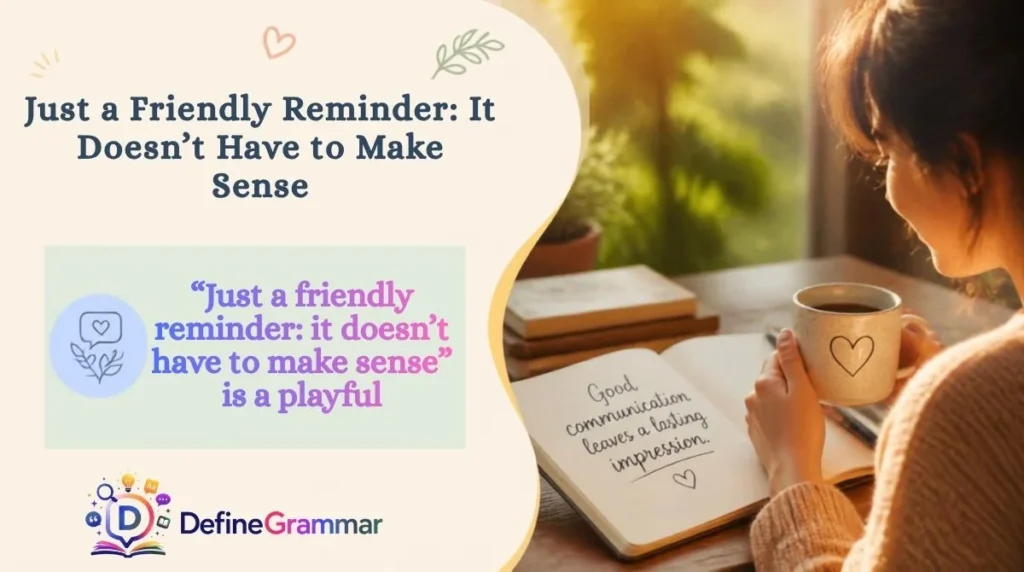
“Just a friendly reminder: it doesn’t have to make sense” is a playful and informal phrase often used to encourage someone not to overthink a situation. It suggests that something may seem confusing, unusual, random, or even illogical, but that does not necessarily make it wrong or meaningless. The phrase can be used humorously when explaining an idea, sharing a thought, or reacting to something that is difficult to understand.
The expression works especially well in casual conversations, social media posts, captions, and messages between friends. “Friendly reminder” makes the statement sound gentle rather than demanding, while “it doesn’t have to make sense” adds a relaxed and humorous tone. Similar uses of “friendly reminder” commonly introduce a helpful point or gentle notice. (MicDelhi)
Depending on the context, the phrase can also communicate that not everything needs a logical explanation. Sometimes people simply want to enjoy an experience, express themselves freely, or accept that certain things are complicated. Its meaning therefore depends heavily on the situation and the tone in which it is used.
Other Ways to Say Just a Friendly Reminder to You
When you want to remind someone about an important task, meeting, payment, or deadline, the way you phrase your message matters. Saying “just a friendly reminder” is polite, but using the same expression repeatedly can make your emails sound repetitive. Choosing different phrases helps your communication feel fresh, professional, and respectful.
Here are some natural alternatives you can use:
- Just a quick reminder
- A gentle reminder
- Kindly remember
- Just checking in regarding
- This is a polite reminder
- I’d like to remind you
- Please keep in mind
- Just following up
- As a reminder
- A quick follow-up
- Just wanted to bring this to your attention
- This is a courteous reminder
- I wanted to touch base regarding
- Please don’t forget
- Just keeping this on your radar
Each expression works well in different situations. For formal business emails, phrases like “This is a courteous reminder” or “I’d like to remind you” are appropriate. For conversations with coworkers or clients you know well, “Just a quick reminder” or “Just checking in” creates a warmer and more conversational tone.
Using varied reminder phrases also improves the readability of your emails and helps maintain a professional relationship with the recipient.
Other Ways to Say Just a Friendly Reminder in Email
Professional emails should be polite without sounding demanding. Instead of repeatedly writing “Just a friendly reminder,” you can choose alternatives that match the tone of your message.
Here are excellent email alternatives:
- Just a quick reminder about our upcoming meeting.
- This is a gentle reminder regarding your response.
- Kindly note that the deadline is approaching.
- Just following up on my previous email.
- I’d like to remind you about the scheduled appointment.
- Please remember to submit the required documents.
- I wanted to check in regarding this request.
- As a reminder, payment is due tomorrow.
- I hope this serves as a helpful reminder.
- Just reaching out to ensure this hasn’t been overlooked.
These expressions are commonly used in business communication because they sound respectful rather than forceful. They also encourage action without making the recipient feel pressured.
When writing reminder emails, always keep your message brief, include the necessary details, and end with appreciation, such as “Thank you for your time” or “I appreciate your attention to this matter.” This creates a positive and professional impression.
How to Say Friendly Reminder Professionally
A professional reminder should sound helpful instead of demanding. Your goal is to encourage someone to take action while maintaining courtesy and respect.
Here are professional ways to say “friendly reminder.”
- This is a gentle reminder.
- Please be reminded that…
- I’d like to kindly remind you.
- As a reminder…
- Kindly note that…
- This is a courteous reminder.
- Please keep in mind that…
- Just following up regarding…
- I wanted to check whether…
- Please don’t forget that…
For example:
- This is a gentle reminder that the project deadline is Friday.
- Please be reminded to complete your registration before Monday.
- Kindly note that the meeting will begin at 10:00 AM.
- As a reminder, your invoice is due next week.
Professional reminder phrases are especially useful when communicating with clients, managers, colleagues, teachers, or business partners because they maintain a respectful tone while clearly delivering the message.
Other Ways to Say Just a Friendly Reminder Funny
Sometimes reminders don’t have to be serious. If you’re messaging close friends, coworkers, or family members, a little humour can make your reminder more enjoyable.
Here are some funny alternatives:
- Your daily reminder has arrived.
- Don’t make me send another reminder.
- Knock knock… remember this?
- Your memory assistant is checking in.
- Consider this your friendly nudge.
- Just sprinkling a little reminder your way.
- My reminder alarm told me to message you.
- The reminder fairy asked me to stop by.
- Before you accidentally forget…
- Your future self will thank you.
Examples:
- Just a tiny reminder before your calendar pretends it never existed.
- Friendly reminder from your unofficial personal assistant.
- Don’t shoot the messenger—I’m only here with a reminder!
These humorous reminders work best with people you know well. Avoid using funny reminder phrases in formal business emails or professional situations where a more respectful tone is expected.
Another Way to Say Friendly Reminder in an Email
Business emails often require polite wording that encourages action without sounding impatient. Fortunately, there are many professional alternatives you can use.
Some effective choices include:
- Just checking in.
- Following up on my previous email.
- I wanted to follow up regarding…
- Kindly note that…
- As previously mentioned…
- Just touching base.
- Please remember…
- I wanted to bring this back to your attention.
- This serves as a reminder.
- I appreciate your attention to this matter.
Example email sentences:
- I wanted to follow up regarding the documents requested last week.
- As a reminder, our meeting is scheduled for Thursday morning.
- Kindly note that the registration deadline is tomorrow.
- Please remember to review the attached proposal before our discussion.
Using different reminder phrases helps your emails sound polished and keeps your communication engaging instead of repetitive.
Just a Kindly Reminder
The phrase “Just a kindly reminder” is not grammatically correct in standard English.
Instead, use one of these correct expressions:
- Just a kind reminder
- Just a friendly reminder
- Kindly consider this a reminder
- Kindly remember
- This is a kind reminder
- Just a gentle reminder
Examples:
- Just a kind reminder that your appointment is tomorrow.
- Kindly consider this a reminder to complete the form.
- This is a gentle reminder about today’s meeting.
The reason is simple: “kindly” is an adverb, while “kind” is an adjective. Since “reminder” is a noun, it should be described by the adjective “kind,” making “kind reminder” the correct phrase.
How to Say This Is a Friendly Reminder
There are many natural ways to introduce a reminder without always writing “This is a friendly reminder.” Choosing different expressions keeps your writing professional and pleasant.
Here are several alternatives:
- Just a quick reminder…
- I’d like to remind you…
- Please remember…
- Kindly note that…
- As a reminder…
- Just checking in…
- Please keep in mind…
- I wanted to follow up…
- Don’t forget…
- Just touching base regarding…
Example sentences:
- Just a quick reminder that your interview starts at 2 PM.
- Please remember to submit your report before Friday.
- Kindly note that the office will be closed on Monday.
- As a reminder, your subscription renews next week.
- I wanted to follow up regarding your application.
These alternatives sound natural in emails, letters, text messages, and workplace communication while remaining polite and professional.
Friendly Reminder Meaning
A friendly reminder is a polite message that helps someone remember an important task, appointment, payment, meeting, or deadline without sounding rude or demanding. The purpose is simply to bring something back to the person’s attention in a respectful and considerate way.
For example, if a colleague hasn’t replied to your email, you might send a friendly reminder instead of assuming they intentionally ignored it. Likewise, businesses often send friendly reminders before appointments or payment due dates to help customers stay informed.
Examples include:
- This is a friendly reminder that your appointment is tomorrow at 10:00 AM.
- Just a friendly reminder to submit your assignment before Friday.
- A friendly reminder that our meeting begins in 30 minutes.
Using a friendly reminder shows professionalism, courtesy, and respect. It encourages action while maintaining positive relationships, making it one of the most effective communication techniques in both personal and professional settings.
People also search
Just a friendly reminder text
Just a friendly reminder synonym
Just a friendly reminder quotes
How to say friendly reminder professionally
Just a friendly reminder examples
Just a friendly reminder messages
Just a friendly reminder: it DOESN’T have to make sense
Just a friendly reminder abbreviation
Frequently Asked Questions
How to professionally say “just a friendly reminder”?
Instead of saying “just a friendly reminder,” you can use phrases like “I’d like to gently remind you,” “This is a courteous reminder,” or “Just checking in regarding.” These alternatives sound professional, respectful, and maintain a positive tone while encouraging action.
What can I say instead of just a reminder?
You can replace “just a reminder” with expressions such as “Kind reminder,” “A quick follow-up,” “As a gentle reminder,” or “I’d like to bring this back to your attention.” These options sound polished and are suitable for emails, workplace communication, and professional follow-ups.
How to say gentle reminder politely?
A polite way to say “gentle reminder” is “I wanted to kindly follow up,” “Just checking in on this,” or “When you have a moment, I’d appreciate an update.” These phrases communicate your message with warmth while respecting the recipient’s time and priorities.
What is a better word for friendly reminder?
Better alternatives to “friendly reminder” include “kind reminder,” “courteous reminder,” “polite follow-up,” “helpful reminder,” or “timely reminder.” Each phrase sounds more professional and works well in business emails, client communication, and formal messages.
What are some positive reminder phrases?
Positive reminder phrases include “Just checking in,” “Whenever you have a chance,” “Looking forward to your response,” “Thank you for your attention,” and “I appreciate your time and assistance.” These expressions encourage cooperation while keeping the conversation friendly, respectful, and professional.
Conclusion
The words you choose for a reminder shape how it lands — the same message can feel considerate or grating depending on the phrase around it. Keep a small rotation of formal, informal, and workplace options on hand, match them to who you’re writing to, and your reminders will always land the way you intend: helpful, not naggy.

Riaz Ahmad is the founder and writer at DefineGrammar.com, dedicated to simplifying English grammar for students and writers worldwide. With a passion for language, he breaks down complex grammar rules into clear, practical lessons, helping readers write with confidence and clarity every day.